
SenseNova U1.5 Technical Report: Toward Native Unified Visual Intelligence
We introduce SenseNova U1.5, a natively unified multimodal model built on an 8B-MoT architecture that understands, reasons about, and generates visual content without external vision encoders or variational autoencoders (VAEs). We improve the visual interface through a reconstruction approach that preserves spatial coherence between image patches, and scale up training with curated generation and editing data, improved task modeling, structured prompt augmentation, and training at native resolutions of up to 4K. During post-training, we separately optimize specialists for visual aesthetics, bilingual text rendering, infographic generation, and image editing, then integrate their capabilities through multi-expert on-policy distillation.
Comprehensive evaluations show that SenseNova U1.5 makes significant progress in image fidelity, text rendering, complex compositions, multi-reference image editing, and interleaved generation, while also improving instruction following and maintaining consistency in subject identity, geometric structure, and non-edited regions. Despite limited coverage of structured formats in the generation training data, the model generalizes effectively to long and complex structured visual instructions, further demonstrating that multimodal understanding can transfer to visual planning and creation.
These results show that native unified modeling offers a promising path toward end-to-end systems that integrate perception, reasoning, and creation. We will open-source the training code, including supervised fine-tuning, reinforcement learning, and on-policy distillation. Code and more information about the model:https://www.sensenova.cn/
SenseNova U1.5 technical report (the community is welcome to follow):https://huggingface.co/papers/2609.11929
SenseTime Raccoon Work online demo:https://office.xiaohuanxiong.com/
GitHub code:https://github.com/OpenSenseNova/SenseNova-U1
Hugging Face model:https://huggingface.co/collections/sensenova/sensenova-u15
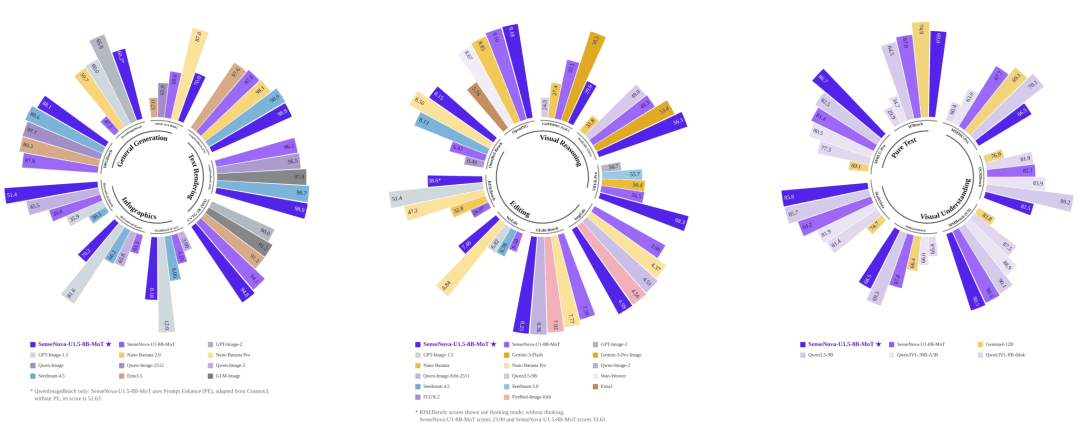
SenseNova U1.5 Evaluation Overview
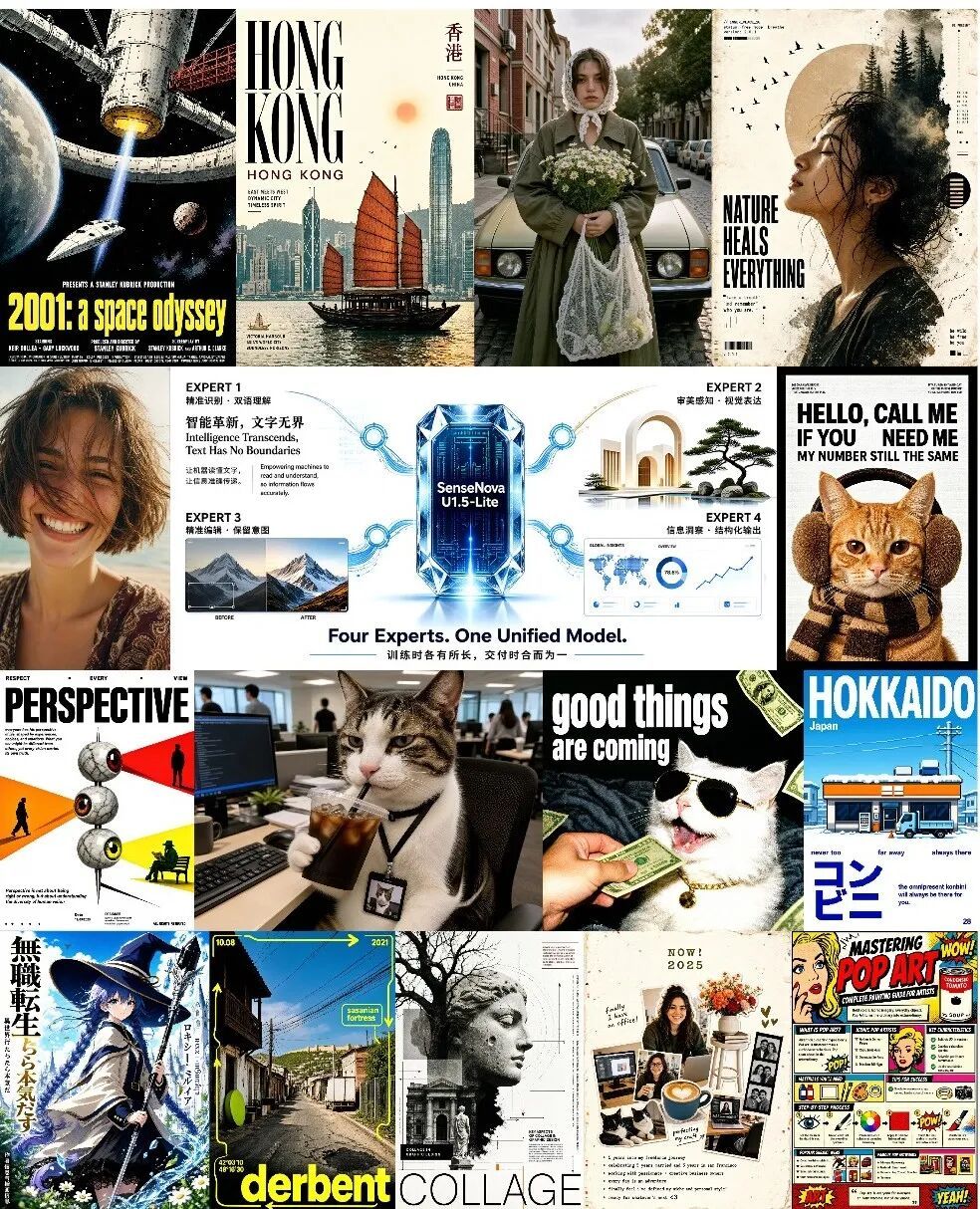
Figure 1. Examples of SenseNova U1.5 generating infographics and people.
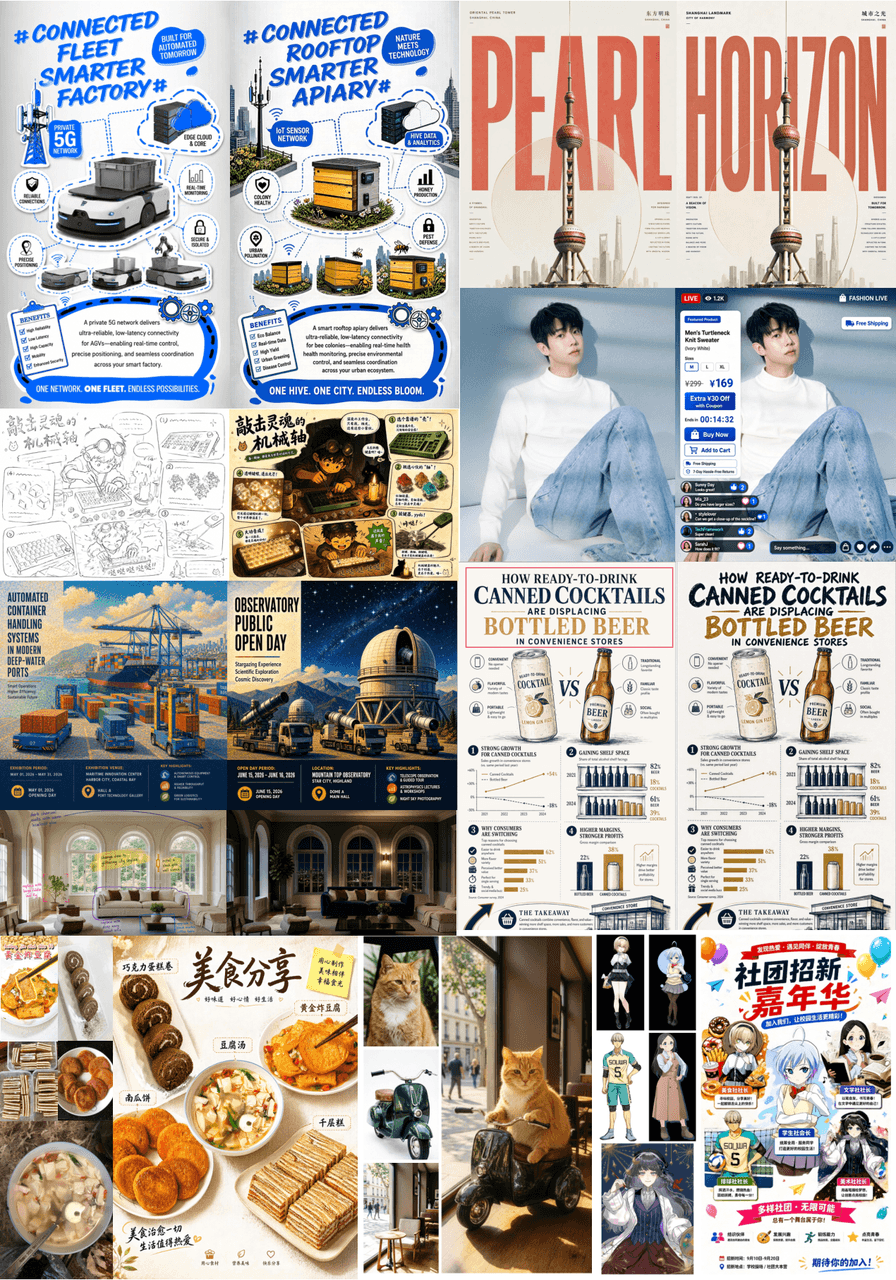
Figure 2. Examples of SenseNova U1.5 performing image editing and multi-reference image generation.
1 Introduction
In recent years, visual generation has rapidly moved beyond traditional image synthesis to become a general-purpose medium for visual creation. It now encompasses multilingual typography and layout, information-dense design, high-resolution rendering, multi-reference image composition, fine-grained object and background editing, and interleaved generation. This expansion, however, has exposed a fundamental architectural divide: most systems perceive images through pretrained vision encoders (VEs) but generate them through variational autoencoders (VAEs). As a result, understanding and generation operate in different representation spaces—the former optimized for semantic abstraction and the latter for pixel-level fidelity. Although this separation is effective, it limits the extent to which perception, reasoning, and generation can work seamlessly together within a unified visual framework across diverse forms of visual creation.
Native unified modeling takes a different approach by learning directly from pixels and text. SenseNova U1 demonstrated the viability of this paradigm through its NEO-unify architecture, which does not rely on external encoders or VAEs and brings perception, reasoning, and pixel-space generation into a single end-to-end model. However, its deliberately lightweight visual interface reconstructs each visual token as an independent RGB image patch. While efficient, this factorized approach prevents the final stage of image formation from exchanging information across neighboring patches, making seams, texture discontinuities, and geometric inconsistencies increasingly pronounced at high resolutions.
This paper introduces SenseNova U1.5, an 8B-MoT native unified multimodal model for visual understanding, reasoning, and generation. Its first major contribution is a fundamental architectural shift: From independent image-patch prediction to spatial joint reconstruction. Rather than mapping each visual token to pixels in isolation, we project the tokens into a two-dimensional feature field and progressively reconstruct the image through spatial convolutions and Pixel Shuffle upsampling. This allows neighboring regions to exchange information before the pixels are finalized, jointly determining color, texture, and geometric structure instead of processing each patch independently. The resulting design retains the efficiency of a compact visual sequence while substantially improving spatial consistency and supporting native generation at resolutions of up to 4K.
The second major advance is a shift from joint reward optimization to a specialize first, unify later strategy. Visual creation encompasses fundamentally different capabilities, including image generation for visual aesthetics, bilingual text rendering, infographic design, and image editing. Each capability involves distinct reward signals, sampling-trajectory dynamics, and optimization challenges. Jointly optimizing these capabilities within a single policy can entangle competing objectives and dilute task-specific gains. We therefore specialize first and unify later: for each capability, we separately optimize dedicated reinforcement learning (RL) experts using tailored data, rewards, sampling strategies, and regularization methods, and then integrate their complementary strengths through multi-expert on-policy distillation. This distillation is performed along the student model」s own generation trajectories, preserving the experts」 complementary strengths while transferring their capabilities into a unified policy.
Extensive evaluations further show that a single native visual representation can serve as a shared foundation for understanding, reasoning, generation, and editing—without parallel visual processing pathways or repeated conversion between encoder features and VAE latents. Although each 32×3-pixel region is compressed into a single visual token, this compact representation still supports efficient inference while delivering strong performance in image fidelity, bilingual text layout, complex composition, multi-reference image editing, interleaved generation, instruction following, visual content preservation, and fine-grained control. More notably, despite limited reliance during training on fixed generation templates, SenseNova U1.5 generalizes to longer, compositional, and highly structured visual instructions. This suggests that the structural knowledge and planning capabilities acquired through multimodal understanding and reasoning can naturally transfer to visual creation. Taken together, these results show that native unification is more than an architectural simplification: a compact, shared visual representation can efficiently support both 「seeing」 and 「creating,」 while allowing capabilities learned through one form of visual intelligence to strengthen the other.
2 Related Work
2.1 Native Unification of Image-Generation Data in Multimodal Models
Native vision-language models (VLMs) process visual inputs directly without relying on external encoders. Models such as Fuyu-8B, EVE, Mono-InternVL, NEO, Gemma4-12B, and Inkling have steadily narrowed the performance gap with leading modular VLMs. A parallel trend has emerged in visual generation: recent studies model pixels directly, demonstrating that high-fidelity synthesis does not necessarily require highly compressed latent spaces. Building on these advances, an increasing number of native unified multimodal models are seeking to integrate understanding and generation within a single framework. Discrete native models unify multimodal learning through token-level autoregression, while continuous native approaches explore end-to-end modeling without explicit tokenizers or latent bottlenecks. Building on NEO-unify, our SenseNova-U series extends this direction toward a fully native foundation architecture, in which understanding, reasoning, and generation emerge from a shared visual foundation.
2.2 Reinforcement Learning for Diffusion Models
In language modeling, reinforcement learning from human feedback (RLHF) established a general post-training paradigm in which learned rewards guide policy optimization, while PPO enables stable updates relative to a reference policy. Notably, GRPO and DAPO improve efficiency and scalability by removing the explicit value model, introducing within-group relative advantages, and adopting improved online optimization strategies. Online reinforcement learning has also expanded into visual generation: ReFL, DDPO, and DPOK optimize diffusion models using preference-based rewards or policy gradients, while AlignProp and D3PO improve efficiency and reduce reliance on explicit reward models. More recently, Flow-GRPO and DanceGRPO have extended within-group relative optimization to diffusion and flow-matching models, improving preference alignment, compositional accuracy, text rendering, and visual quality.
For flow-matching models, online reinforcement learning must introduce stochastic exploration beyond deterministic ordinary differential equation (ODE) inference. Flow-GRPO enables this exploration through sampling trajectories based on stochastic differential equations (SDEs). Coefficients-preserving sampling (CPS) and Precise improve few-step sampling by better preserving the underlying flow dynamics and balancing exploration with distributional fidelity. Beyond sampling, GRPO-Guard mitigates reward overoptimization through controlled clipping and noise-aware gradient reweighting. Existing approaches to vision reinforcement learning also rely on capability-specific rewards, including preference models that assess perceptual quality and text-image alignment, as well as specialized rewards for typography and editing. Inspired by these advances, we use task-dependent reinforcement learning post-training that combines CPS or Precise sampling with alternating rewards or task-specific rewards to address the distinct optimization requirements of generation and editing.
2.3 On-Policy Distillation for Unified Models
Recently, on-policy distillation (OPD) has addressed the distribution mismatch problem in conventional knowledge distillation by providing students with dense supervision from teachers on trajectories generated by the students themselves. Building on this paradigm, MOPD extends OPD to integrate capabilities from multiple teachers: independently optimized domain experts supervise the student's on-policy sampling trajectories, thereby consolidating multiple reasoning capabilities into a single model. Beyond language modeling, OPD has also been applied to multimodal understanding and reasoning, with teachers supervising multimodal trajectories generated by students. Its applications have recently expanded to visual generation. Specifically, Flow-OPD, DiffusionOPD, and DanceOPD distill task-specialized generators along student-generated denoising trajectories using teacher consistency signals, transition matching, and velocity-field regression, respectively. DiffusionOPSD, meanwhile, removes the external teacher and uses differentiable reward gradients to construct a bounded self-distillation objective. Our approach is complementary to these methods: rather than forcing all tasks to use a single distillation scheme, we retain four task-specialized external experts and use hard routing to feed their supervision signals into the same native pixel-space model. This design integrates specialized capabilities while preserving each expert's task-dependent conditional inputs, guidance methods, and resolution strategies.
3 Method
3.1 Model Architecture
Near-Lossless Visual Interface SenseNova U1.5 retains the lightweight native vision interface proposed by NEO, directly transforming raw images or noised visual inputs into compact token sequences without an external vision encoder or VAE. Specifically, two convolutional projections with GELU activations perform 16× and 2× downsampling, respectively, so that each 32 × 32 image region corresponds to one visual token. Two-dimensional sinusoidal positional embeddings preserve spatial coordinates, while special tokens delimit individual visual blocks. Text is tokenized using the original language tokenizer, after which the visual and textual representations are projected into a shared hidden space and jointly processed by a unified backbone. This design preserves nearly lossless visual information while keeping sequence lengths within a range manageable for large-scale multimodal modeling.
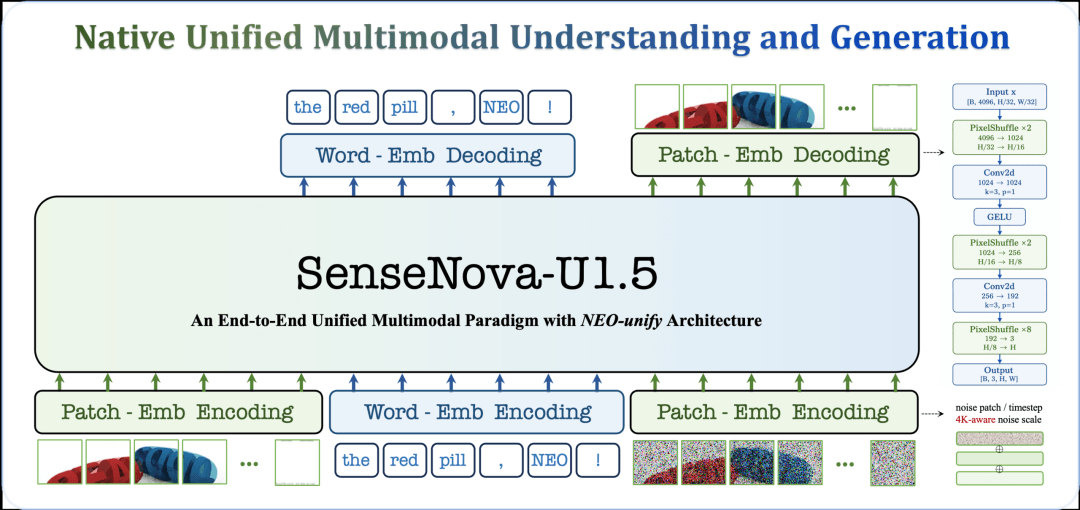
Figure 3. Overview of SenseNova U1.5. Compared with SenseNova U1, U1.5 further improves the near-lossless vision interface at both the encoding and decoding ends. Resolution-aware noise conditioning is extended to 4096 × 4096, and the original per-image-block MLP output head is replaced with a lightweight spatial decoder that uses Pixel Shuffle and 3 × 3 convolutions. These improvements retain the compact representation in which each 32 × 32 pixel region corresponds to one visual token, while enhancing spatial continuity, high-resolution fidelity, and downstream robustness.

Table 1. SenseNova U1.5 configuration. The model uses a higher spatial compression ratio, a Pre-Buffer design, native RoPE for unified spatiotemporal encoding, and a Mixture-of-Transformers architecture for joint multimodal understanding and generation.
For generation tasks, the effective noise magnitude varies with image resolution, making resolution an important condition for the denoising process. SenseNova U1.5 explicitly introduces resolution-dependent noise-scale embeddings,and expands the reference image resolution from 2048 × 2048 to 4096 × 4096 to better support native high-resolution generation. The model normalizes and encodes the corresponding noise scale, then fuses it with the diffusion timestep representation. This enables the denoiser to account for both the current denoising stage and resolution-related noise characteristics, allowing it to adapt more stably to different resolutions and aspect ratios.
Compact image-block partitioning reduces the cost of image modeling, but independently decoding each image block with an MLP can disrupt local continuity, resulting in seams, grid artifacts, and texture discontinuities at high resolutions. To address this issue, SenseNova U1.5 replaces the original MLP output head with a lightweight spatially coupled decoder. As shown in Figure 3, the decoder first restores the visual tokens output by the backbone to a two-dimensional feature map, then progressively reconstructs a full-resolution RGB image through three stages of Pixel Shuffle upsampling. Local convolutions between stages allow adjacent regions to exchange information and jointly determine pixels near image-block boundaries, rather than predicting each block independently.
The decoder restores local spatial interactions before pixel synthesis, enabling global semantics, composition, and fine-grained structure to be jointly optimized within a single end-to-end framework. It is trained together with the backbone network under a flow-matching objective. With only a modest increase in computational overhead, it improves cross-patch consistency and local continuity, reduces boundary artifacts, and enhances the stability of high-resolution generation and downstream adaptation.
Native Mixture-of-Transformers. SenseNova U1.5 retains a native Mixture-of-Transformers (MoT) design, integrating understanding and generation within a single Transformer backbone rather than separating them into two fully independent networks. Clean image-text context and noise-conditioned visual states are interleaved in a unified sequence, allowing semantic representations, visual evidence, and generation dynamics to interact directly through shared self-attention. This design enables the generation process to continuously leverage representations formed during multimodal understanding, without introducing auxiliary fusion modules or cross-space feature transformations.
The attention patterns are structurally designed to coordinate causal language modeling with bidirectional visual interaction. Text tokens attend only to preceding context, while tokens within each clean image patch attend bidirectionally to capture spatial dependencies. Noise-conditioned generation tokens likewise interact bidirectionally within their respective image patches and attend to all preceding clean multimodal context. The reverse information path is explicitly masked, preventing clean representations from accessing randomly generated states. This asymmetric information flow allows the generation process to leverage rich semantic and visual context while preserving the integrity of the representations used for understanding and reasoning.
Crucially, architectural unification does not mean that all positions share the same parameters. Understanding and generation retain separate attention projections, normalization layers, and feed-forward modules, with tokens dynamically routed by type at each Transformer layer. Shared attention therefore serves as an interface for communication across streams, while stream-specific parameters preserve the distinct computations required for perception and synthesis. This combination of dense interaction and parameter specialization allows both capabilities to benefit from a shared representation space without forcing their different optimization objectives into the same computational pathway.
Unified training objectives. SenseNova U1.5 combines autoregressive language modeling, pixel-space flow matching, and perceptual supervision to jointly train understanding and generation capabilities within a single model.
For multimodal understanding, the model sequentially predicts subsequent text tokens based on the existing image-text context and preceding text. By increasing the probability of correct predictions, it learns semantic understanding and multimodal reasoning.
For visual generation, the model learns a continuous transformation from noise to images directly in RGB pixel space. During training, real images are mixed with Gaussian noise whose scale is adjusted to the target resolution, creating noisy states corresponding to different stages of generation. From these states, the model predicts the clean image and uses it to estimate the velocity of the generation trajectory, then minimizes the difference between the predicted and target velocities through a flow-matching loss.
Building on this foundation, the model introduces LPIPS perceptual loss to compare predicted and ground-truth images in feature space. This further constrains structural consistency, local texture, and visual coherence, complementing the supervisory signal in pixel space. The three types of loss are combined by weight and jointly optimized, allowing semantic understanding, image generation, and visual quality constraints to work together so that high-level semantics and low-level visual generation are learned jointly within a unified representation.
3.2 Training Process
SenseNova U1.5 progressively develops native multimodal capabilities through generative pretraining, unified mid-training, and unified supervised fine-tuning (Stages 1–3), as detailed in Table 2. It then undergoes capability-specific learning (Stage 4) and multi-expert same-policy distillation (Stage 5).
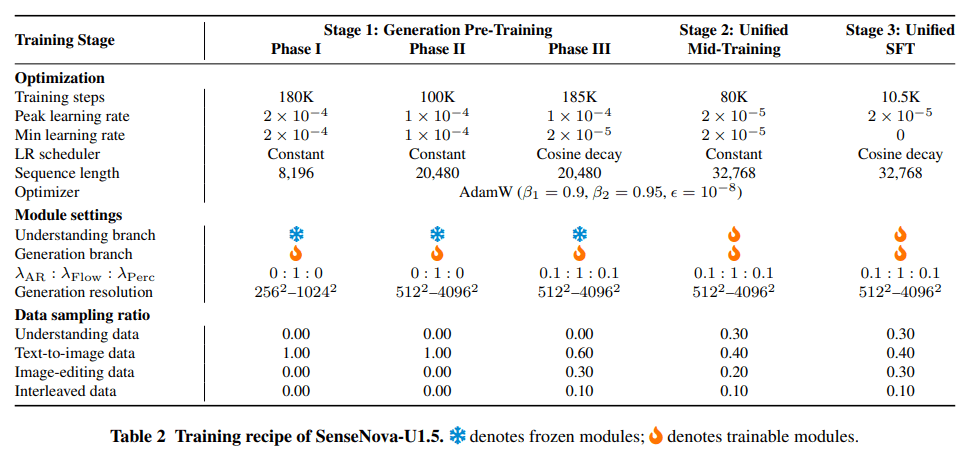
Table 2. Training configuration for SenseNova U1.5.
Stage 1: Generative Pretraining. Building on the pretrained understanding branch, we randomly initialize the generative branch and train it with pixel-space flow matching, conditioned on representations provided by the frozen understanding branch. SenseNova U1.5 increases the computational budget and introduces a dedicated native 4K training stage. Training initially uses text-to-image data at resolutions ranging from 256×256 to 1024×1024. During this stage, we train for 180K steps at a constant learning rate of 2×10⁻⁴ and a sequence length of 8,196. We then expand the text-to-image data to higher resolutions ranging from 512×512 to 4096×4096 to enhance the model」s native 4K generation capabilities. This stage runs for 100K steps at a constant learning rate of 1×10⁻⁴ and increases the sequence length to 20,480. In the final stage, we introduce image editing and interleaved generation tasks and continue training for 185K steps, extending the model」s generative capabilities to a range of downstream scenarios. The mixed training data consists of 60% text-to-image data, 30% image-editing data, and 10% interleaved image-text data. We use a cosine learning-rate schedule, decaying the learning rate from 1×10⁻⁴ to 2×10⁻⁵, while maintaining a sequence length of 20,480. Starting at this stage, we add LPIPS-based perceptual loss to the flow-matching objective, with a weight of 0.1, to improve the generation of fine-grained visual details and local visual coherence. Notably, this combined generative objective remains unchanged in the subsequent unified mid-training and supervised fine-tuning stages.
Stage 2: Unified Mid-Training. We jointly optimize the two branches, using shared attention to facilitate information exchange across branches while retaining task-specific representations. To balance general-purpose multimodal capabilities with diverse generative capabilities, we construct a mixed corpus consisting of 30% pure-text and multimodal understanding data, 40% text-to-image data, 20% image-editing data, and 10% interleaved image-text data. This mixture exposes the model to complementary forms of perception, synthesis, editing, and multimodal interaction during unified training. The model is trained for 80K steps with a maximum sequence length of 32,768 tokens and a constant learning rate of 2×10⁻⁵ . The weights of the understanding and generative losses are 0.1 and 1.0, respectively. This weighting helps preserve pretrained understanding capabilities while assigning greater optimization weight to the more challenging generative objective, enabling stable joint training and more effective capability integration.
Stage 3: Unified Supervised Fine-Tuning. We further fine-tuned the model on carefully curated, high-quality instruction-following data, with a task composition similar to that of Stage 2. This stage further enhanced instruction following and consolidated the capabilities acquired during early training into a unified model. Training ran for 10.5K steps using a cosine learning-rate schedule, decaying the learning rate from 2×10⁻⁵to 0 while retaining the same loss coefficients as in Stage 2 to maintain a balance between the understanding and generation objectives.
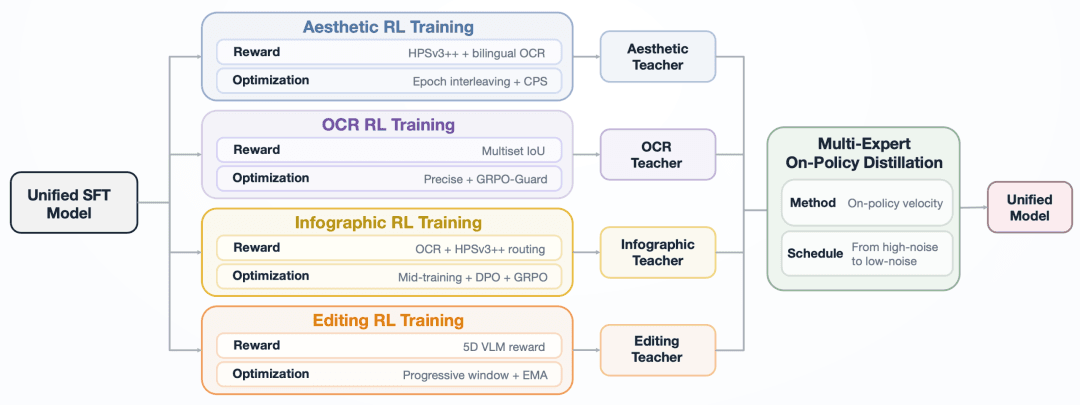
Figure 4. The post-training process for SenseNova U1.5, including multi-expert reinforcement learning and on-policy distillation.
Stage 4: Multi-Expert Reinforcement Learning. As shown in Figure 4, we trained four experts separately for aesthetics, text rendering, infographic generation, and image editing. Each expert used task-specific data, rewards, sampling, and regularization settings.
(1) Aesthetic Expert. Optimizing only for visual preferences may improve overall appearance at the expense of text legibility. Therefore, we alternated between aesthetic preference data and typography data across training epochs to train the aesthetic expert. Samples from each data partition were routed to task-specific rewards: HPSv3++ evaluated perceptual quality and prompt-image alignment, while a bilingual OCR reward based on PaddleOCR measured text fidelity. This routing avoided mixing rewards with different scales and semantics while preserving typographic accuracy during preference optimization.
For each prompt, we generated 16 candidate results using 30-step trajectories, a guidance scale of 4.0, and a timestep shift of 3. We used coefficient-preserving sampling (CPS) with η = 0.7 to reduce the limited-step artifacts associated with conventional SDE sampling while introducing stochastic exploration.
For each update, we uniformly sampled a contiguous five-step window from the first 10 steps of the trajectory, focusing optimization on the early denoising stage that primarily determines global content and composition. Training used dynamic resolutions and aspect ratios, with a constant learning rate of 2×10⁻⁵and a reference-policy KL coefficient of 0.01. To reduce reward-induced drift, we froze the final Transformer block of the generation branch, the flow-matching output head, and its output normalization layer during reinforcement learning.
(2) OCR Expert. The OCR expert specifically improves the model」s ability to render bilingual text accurately. For each prompt, we extracted the text expected to appear in the image as the target and used PaddleOCR to recognize the generated content. We then calculated the normalized multiset intersection-over-union between the recognized and target text, matching English by word and Chinese by character. Compared with exact-match rewards, this graded reward better reflects partially correct generations while remaining sensitive to omissions, repetitions, and rendering errors.
We generated 16 candidate results for each prompt using 30-step trajectories, a guidance scale of 4.0, and a timestep shift of 3, and sampled a contiguous five-step optimization window from the first 10 steps. Trajectory sampling used Precise sampling with a coefficient of 1.5, while GRPO-Guard stabilized optimization in the presence of sparse high OCR rewards. Training used dynamic resolutions and aspect ratios, with a constant learning rate of 2×10⁻⁵, with a reference-policy KL coefficient of 0.02. We likewise freeze the final Transformer block, flow-matching output head, and output normalization layer of the generation branch during reinforcement learning.
(3) Editing Expert. Effective image editing requires balancing three objectives: instruction following, preservation of unedited content, and the visual quality of the edited region. Under-editing may result in only partial execution of the instruction, while over-editing may alter content that should remain unchanged. The Editing Expert must therefore learn what to modify, what to preserve, and how to integrate the requested changes naturally into the source image.
The Editing Expert uses a constant learning rate of 4×10⁻⁵ , a KL coefficient of 0.01, a trajectory sampling group size of 24, and a noise scale of 0.7, together with an exponential moving average (EMA). We avoid SDE-based trajectory sampling because excessive stochastic perturbations may introduce residual noise and visual artifacts. Under this setup, we further introduce two editing-specific strategies to provide targeted reward supervision and improve optimization.
(i) Multidimensional Rewards. We use a VLM-based reward framework to evaluate editing quality across five dimensions: instruction completion, editing execution, overall visual quality, text-editing quality where applicable, and preservation of unedited regions. These complementary signals provide targeted supervision for different failure modes while balancing editing accuracy, visual fidelity, and content preservation.
(ii) Progressive Training. We adopt a progressive sliding-window strategy that gradually shifts the optimization focus from the early stages of establishing semantics to the later stages of refining texture. This coarse-to-fine progression first ensures the intended structural changes, then improves local fidelity and visual integration with the surrounding content.
(4) Infographic Expert. Infographic generation requires accurate text rendering, coherent dense layouts, clear information hierarchy, and high overall visual quality. The Infographic Expert first undergoes a complete training process spanning infographic-oriented mid-training and task-specific reinforcement learning, with the goal of achieving more substantial improvements in small-font text rendering and related capabilities. During mid-training, we introduce high-quality real and synthetic data, rebalance the distribution across infographic subcategories, and adjust the mixing ratio of infographic data with data from other categories. This further improves small-font text rendering, complex layout handling, information organization, and overall visual design quality.
We then further optimize the Infographic Expert in three stages. The first stage uses the same training data and text-fidelity reward as the OCR Expert to improve text rendering. In the second stage, we apply direct preference optimization (DPO) to carefully selected preference pairs to improve overall visual quality; the constant learning rate is 5×10⁻⁶ , the DPO loss coefficient is 10, and one timestep is sampled from steps 1–20 for each update. In the final stage, we alternate between text-rendering data and aesthetic data, routing them separately to the text-fidelity reward and HPSv3++, rather than combining the two scores.
Both the first and final stages use Group Relative Policy Optimization (GRPO) with coefficient-preserving sampling (CPS), generating 16 candidate results for each prompt over 30-step trajectories. Classifier-free guidance is used only when collecting sampled trajectories for reward evaluation, while the policy objective is computed solely from conditional predictions. The constant learning rate in both stages is 2×10⁻⁵ , and the reference-policy KL coefficient is 0.01 in both stages.
Stage 5: Multi-Expert On-Policy Distillation. As shown in Figure 4, we use on-policy velocity-field distillation to integrate the capabilities of four experts— aesthetics, text rendering, infographic generation, and image editing—into a single unified model. Each training sample is assigned to the corresponding frozen expert based on its capability category. The student model first generates its own denoising trajectory from text or image-text conditioning. The student and expert then separately predict the velocity of the generation process at the same intermediate state, timestep, and input condition. Training transfers the expert capabilities to the student by minimizing the squared error between their velocity predictions.
During this process, the sampled intermediate states are treated as fixed inputs, and gradients are not backpropagated through the complete sampling trajectories. Each training round uses data from only one capability and its corresponding expert, with capabilities rotated in a fixed order.
Text-to-image generation and image editing both use deterministic 30-step ordinary differential equation (ODE) denoising, with the expert queried at only one timestep per trajectory. The query position is sampled from a Beta distribution that changes over the course of training: early training focuses more on the high-noise states at the beginning of the trajectory to learn global structure, then gradually shifts toward the low-noise states at the end to strengthen detail and text fidelity. To maintain consistency between training and inference, we directly optimize velocity predictions under classifier-free guidance (CFG). The guidance scale is 4 for the aesthetics, OCR, and infographic experts, with global-norm clipping applied; the guidance scale is 1 for the editing expert.
For text-to-image generation, we first select a target area from 10242, 15362, 20482, 30722, and 40962, and select a target aspect ratio from 1:1, 16:9, 9:16, 4:3, 3:4, 3:2, 2:3, 1:2, and 2:1.The width and height are calculated while preserving the target area, and the dimensions are rounded to the nearest multiple of 32 pixels. Image editing uses the source image resolution, with only the same dimension rounding applied.
The student model is trained for 800 optimizer steps, with a global batch size of 128, one gradient accumulation step, and 25,600 samples per domain. Training uses the AdamW optimizer, a learning rate of, decay coefficients of 0.9 and 0.999 for the first- and second-moment estimates, respectively, weight decay of 2×10⁻⁵, a maximum gradient norm of 1, and BF16 mixed precision. The final three layers of the understanding branch, the final three layers of the generation branch, and the generation output head remain frozen. Sampling follows the 30-step trajectory configuration but terminates immediately after the selected query transition is completed, avoiding computation of trajectory steps that will not be used.
3.3 Reward Modeling
Aesthetic Reward.Aesthetic quality reflects composition, visual fidelity, semantic consistency, stylistic coherence, and human preferences, making it difficult to capture adequately with a single manually designed objective. We therefore use HPSv3++ to provide a preference reward. Its training approach accounts for differences in model capability and the iterative training process, making it suitable for reinforcement learning post-training in which generation quality continues to improve and the output distribution constantly changes. Compared with scorers trained on a fixed generation distribution, it provides more robust and adaptive preference supervision, helping the model improve perceptual quality while reducing overfitting to narrow reward objectives.
OCR reward.Preference rewards alone are insufficient to guarantee textual accuracy, because an image that is visually plausible may still contain missing or repeated text, or incorrect glyphs. We therefore introduce an explicit OCR reward: we extract the target text from the prompt, use PaddleOCR to recognize text in the generated image, and normalize case, punctuation, and whitespace. English text is tokenized by word, while Chinese text is tokenized by character.
We use multiset intersection-over-union for scoring. For each word or character, we count its occurrences in the target and recognized texts, respectively. The smaller count contributes to the match count, and the larger count contributes to the total count; the reward is the aggregate match count divided by the aggregate total count. This approach rewards correctly rendered text while penalizing omissions, extraneous text, and erroneous repetition. It also handles the unreliable OCR reading order that can occur in dense layouts or layouts with multiple regions more robustly.
During post-training, aesthetic prompts and OCR prompts use their respective rewards and are alternated across training iterations, avoiding the mixing of rewards with different scales within a single sample.
Infographic reward. We do not introduce an additional infographic-specific reward model. Instead, we reuse the OCR and aesthetic rewards according to the training stage and task type. The first training stage uses only the OCR reward for warm-up, prioritizing text fidelity. In the final training stage, rewards are assigned based on the prompt category: text-rendering prompts use the OCR reward, while aesthetic prompts use HPSv3++.
The two scores are neither added together nor normalized against each other. This task-based routing preserves their respective scales and semantics while providing complementary supervision for textual accuracy and perceptual quality.
Editing reward.Rewards for image editing must determine not only whether the requested changes were completed, but also whether the result is visually credible and whether source content unrelated to the edit has been preserved. A single overall score can obscure different types of errors, allowing strength in one aspect to offset a critical failure in another. We therefore evaluate editing quality across multiple dimensions.
These include:Instruction completion measures the semantic correctness of the edited result and the completeness of the requested changes;Editing execution quality evaluates the visual quality of the target region and how naturally it blends with the surrounding content;Overall visual qualityexamines overall technical quality and consistency with the intended style;Text editing quality when text is modified, evaluates textual accuracy and rendering quality;Preservation of unedited regionscompares the source image with the edited result and penalizes unintended semantic, structural, or visual changes outside the target region.
For evaluation criteria comprising multiple subdimensions, we retain the lowest score among them. After normalizing the scores for each criterion,the final reward is the lowest value across all applicable dimensions, rather than their average. When no text is modified, the text editing score is excluded. If none of the requested changes is visible in the image, the editing execution score is set to 0.
This weakest-link approach, in which the overall reward is determined by the lowest-scoring dimension, prevents high scores in one dimension from masking critical errors in others. It keeps the reward sensitive to incomplete edits, unintended modifications, and localized quality defects, providing more balanced and reliable supervision for reinforcement learning in image editing.
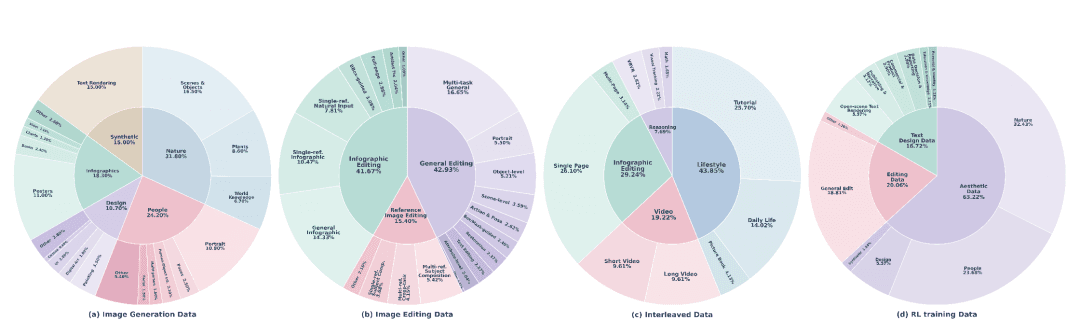
Figure 5. Training corpus of SenseNova U1.5. From left to right, the charts show the hierarchical composition of the image generation, image editing, interleaved generation, and reinforcement learning training datasets, respectively. The inner rings represent the main data categories and their proportions, while the outer rings further break them down into fine-grained subcategories.
4 Data Construction
As shown in Figure 5, SenseNova U1.5 substantially expands the training corpus of SenseNova U1, with a focus on improving data diversity, visual quality, high-resolution generation, complex instruction following, and fine-grained image editing. In addition to increasing the data volume, we systematically improved data filtering and curation through quality-aware selection, distribution rebalancing, stronger image-text alignment, and targeted synthesis for capabilities with insufficient coverage.
4.1 Image Generation Data
The image generation corpus combines large-scale real-world image-text pairs, carefully selected public and proprietary sources, and high-quality synthetic data. Compared with SenseNova U1, we added approximately 59 million image-text pairs from 78 sources, significantly broadening the training distribution to cover general-purpose scenarios, people-centric content, objects and materials, richly textual images, infographics, and other specialized visual domains.
Importantly, high-resolution samples account for a substantial proportion of the overall training mix: approximately 88.2% of the effective training data has a resolution exceeding 10242 and approximately 64.4% exceeds 20482. This exposes the model to rich visual statistics across a range of spatial scales, providing supervision not only for globally coherent scene composition and layout, but also for fine-grained local structures, textures, materials, and other high-frequency visual details.
To improve instruction alignment, we created image descriptions at different levels of granularity, ranging from lengthy, detailed descriptions to concise captions and lightweight semantic tags. We further strengthened coverage in both Chinese and English, particularly for richly textual images, and explicitly verified that the language and text specified in the prompt matched the content actually rendered in the image. To supplement real-world data, we collected web-scale data and conducted targeted synthesis for rare concepts, complex layouts, and text-dense designs. Both synthetic and real samples passed through the same filtering pipeline, which jointly evaluated perceptual quality, prompt fidelity, text correctness, layout quality, and visual diversity to ensure a high-quality, balanced training distribution.
4.2 Image Editing Data
Our image-editing corpus contains approximately 38 million examples designed to cover four complementary settings: general image editing, infographic editing, reference-conditioned editing, and spatially controllable editing. Together, these settings span a broad range of editing scenarios, including local attribute modification, object insertion and removal, scene-level transformation, pose and action editing, inpainting and enhancement, text and layout manipulation, reference-guided customization, and region-controlled operations. To improve robustness beyond fixed instruction patterns, we diversify both the underlying visual content and the wording, granularity, and complexity of the editing instructions. For challenging edits involving multiple targets or constraints, we further incorporate structured-prompt augmentation examples and chain-of-thought examples that explicitly represent the editing intent, target regions, desired attributes, spatial or semantic constraints, and content that should remain unchanged. This structured supervision reduces instruction ambiguity and provides stronger guidance for precise, faithful editing that prioritizes content preservation.
Approximately 43% of the corpus consists of general editing examples, while approximately 42% comprises spatially controllable infographic editing examples. A further 15% is a reference-conditioned subset supporting both single-reference and multi-reference image editing. The infographic data combines procedurally rendered source–target image pairs with model-generated examples, enabling precise control over text, visual elements, layout structure, and overall style. The reference-conditioned data emphasizes subject and identity preservation, attribute transfer, compositional blending, and controllable transformations of viewpoint, pose, geometric structure, and lighting, with up to 10 reference images per example. The spatially controllable data introduces explicit region-level guidance through bounding boxes and visual markers, supporting more precise and interactive operations. Across all editing settings, data filtering jointly evaluates instruction completion, target quality, reference or identity fidelity where applicable, and the preservation of content outside the intended editing region.
4.3 Interleaved Image–Text Data
The largest share of the corpus consists of trajectories centered on everyday life, accounting for approximately 44% and including step-by-step tutorials, everyday scenarios, and picture-book narratives. These examples provide rich supervision for maintaining long-range semantic coherence, visual consistency, and cross-modal dependencies across alternating text and image segments. Infographic data accounts for a further 29%, with an emphasis on structured composition, dense textual content, and the coordinated generation of language and visual elements. Video-derived sequences account for approximately 19%, introducing temporal evolution, state transitions, and cross-frame dependencies. The remaining 8% consists of reasoning-intensive examples enhanced with explicit intermediate reasoning for complex, multi-step understanding and generation.
We do not treat these sources as isolated task collections. Instead, we convert them into a unified trajectory format in which textual and visual states are interleaved step by step. This unified representation exposes the model to a broad range of multimodal dependencies, from local image–text correspondences to long-range semantic progression, temporal continuity, and reasoning-conditioned generation across multiple steps. Notably, all trajectories are constructed through a shared pipeline that combines source-data preprocessing, domain-specific transformation or synthesis, and trajectory-level validation. The resulting corpus undergoes joint filtering for linguistic validity, visual quality, cross-modal consistency, and the coherence and correctness of the complete multimodal progression.
4.4 Reinforcement Learning Training Data
Aesthetic, OCR, and infographic samples. For the aesthetic samples, we combined HPSv3++, Pick-a-Pic, bilingual prompts expanded with Cosmos3PE, and internally generated prompts to construct approximately 280,000 prompts covering a wide range of subjects, styles, compositions, and spatial configurations. Multiple images were generated for each prompt and scored with HPSv3++; prompt groups with small reward differences were removed to retain examples that provide more discriminative relative supervision. The OCR corpus contains approximately 60,000 bilingual text-rendering prompts, with balanced coverage of Chinese and English. This includes approximately 20,000 short-text prompts collected from Flow-GRPO, which were further rewritten and expanded into approximately 40,000 longer prompts with denser text and more complex rendering requirements. The specified text was extracted from each prompt and used as the reference transcription for online OCR reward calculation. For infographic samples, the first GRPO stage reused the OCR corpus, while subsequent GRPO stages alternated between OCR and aesthetic prompts according to task-specific rewards. We also introduced approximately 120,000 preference pairs selected from the Linear-DPO corpus for DPO, further balancing portrait and non-portrait content as well as Chinese and English prompts to improve overall visual preference alignment.
Image Editing Samples. The editing expert was trained on approximately 120,000 examples, with local and global edits accounting for approximately 80% and 20%, respectively. Local edits include infographic and document operations, scene-level and object-level edits, human action and pose adjustments, portrait retouching, text replacement, image restoration and enhancement, and edits conditioned on bounding boxes or masks; global edits focus on coherent image-level transformations. The data contains Chinese, English, and mixed-language instructions, with instruction lengths balanced across predefined ranges and training resolutions covering 512 × 512 to 2048 × 2048.Data filtering was conducted in three stages. First, corrupted, duplicate, low-resolution, or visually degraded samples were removed, while a range of common aspect ratios was retained. Next, we verified that the entities, text, spatial regions, and visual attributes specified in each instruction had corresponding evidence in the source image, and that the target image faithfully implemented the requested modifications. Finally, the source and edited images were evaluated for aesthetics, technical quality, and structural and textural richness, using conservative pairwise aggregation to surface deficiencies in either image. The retained samples were then rebalanced by task category and resolution tier to form a diverse and challenging distribution.
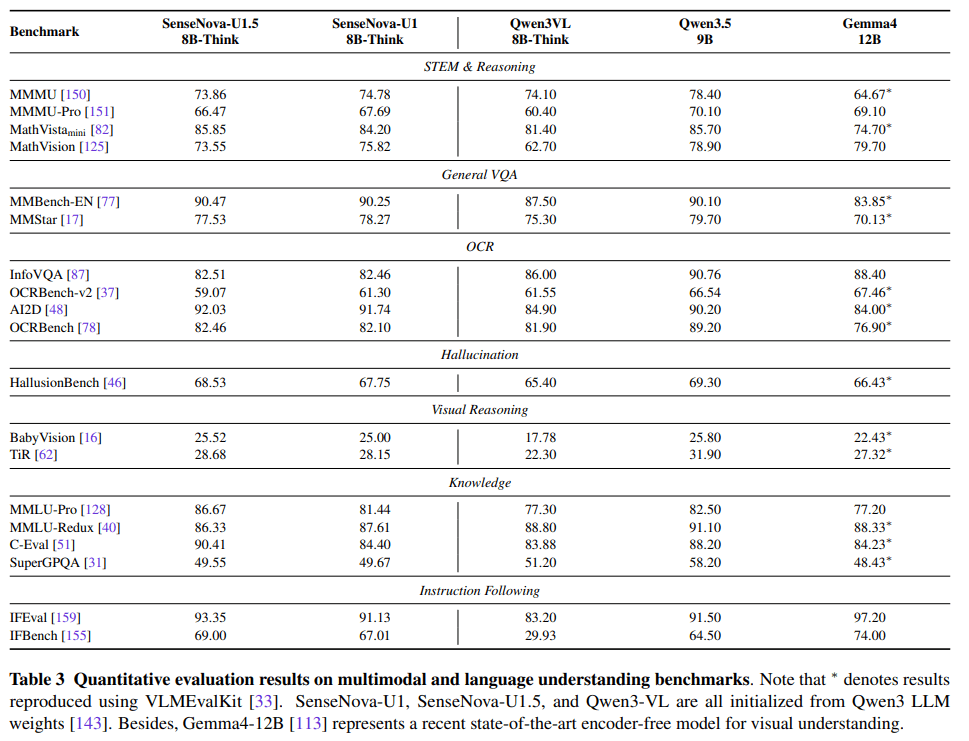
Table 3. Quantitative evaluation results on multimodal and language understanding benchmarks.
5 Experiments
5.1 Evaluation of General Understanding Capabilities
Multimodal Understanding. As shown in the figure, SenseNova U1.5 delivers strong performance across a range of multimodal benchmarks, covering STEM reasoning, general visual question answering (VQA), OCR, hallucination, and visual reasoning. Compared with SenseNova U1, U1.5 substantially expands image generation and editing capabilities while maintaining or improving performance on most benchmarks, demonstrating that stronger generative modeling does not come at the expense of visual understanding. Specifically, U1.5 achieves competitive results on MMMU, MathVista, MMBench, MMStar, AI2D, OCRBench, HallusionBench, BabyVision, and TiR, matching or surpassing strong modular baselines such as Qwen3-VL on many tasks. Notably, despite using an architecture that does not rely on external encoders, U1.5 also compares favorably with the recent encoder-free model Gemma4-12B on multiple visual understanding evaluations, highlighting the effectiveness of native multimodal unification for general perception and reasoning.
Language Understanding. In addition to its multimodal capabilities, SenseNova U1.5 retains strong language understanding and instruction-following abilities following unified multimodal training. Its performance on MMLU-Pro and C-Eval is particularly notable, reaching 86.67 and 90.41, respectively, while remaining competitive on MMLU-Redux and SuperGPQA. More importantly, U1.5 delivers a significant improvement in instruction following over SenseNova U1, achieving 93.35 on IFEval and 69.00 on IFBench. This demonstrates that the visual generation and editing capabilities introduced in U1.5 do not substantially weaken its underlying language abilities. Instead, while retaining a solid foundation in text-based reasoning, the model supports a significantly broader range of multimodal capabilities within the same unified model.
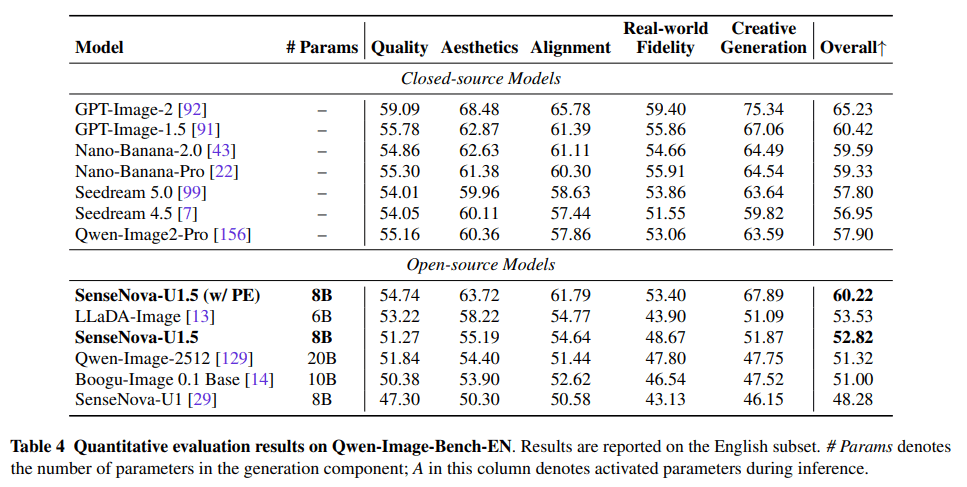
Table 4. Quantitative evaluation results on Qwen-Image-Bench-EN
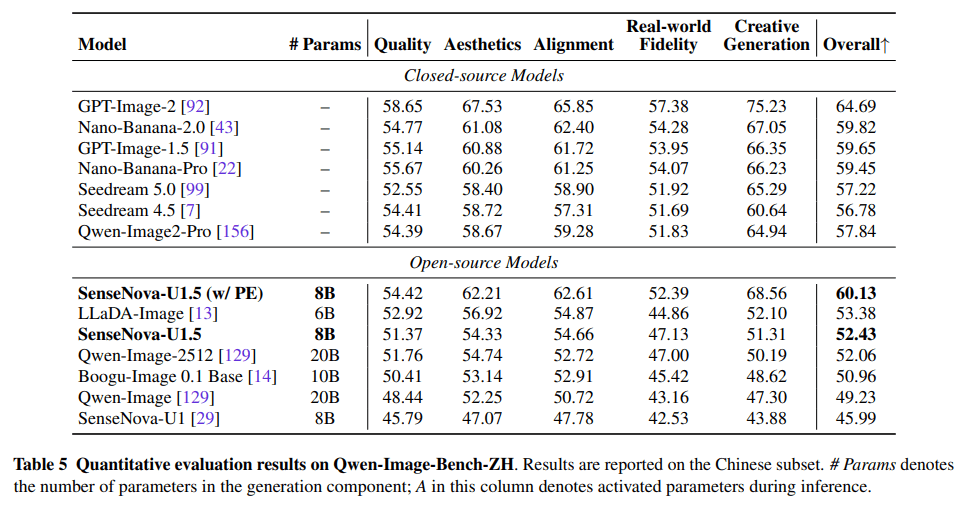
Table 5. Quantitative evaluation results on Qwen-Image-Bench-ZH
5.2 Image Generation
General-Purpose Generation. We evaluate general text-to-image generation capabilities on Qwen-Image-Bench, GenEval, GenEval2, DPG-Bench, and OneIG-Bench, covering visual quality, prompt alignment, compositional generation, dense instruction following, text rendering, style, and diversity.
Qwen-Image-Bench. As shown in Tables 4 and 5, SenseNova U1.5 delivers strong overall performance on both the English and Chinese subsets of Open-Image-Bench. With prompt enhancement, it achieves scores of 60.22 and 60.13, respectively, attaining the best overall performance among the open-source models evaluated. Even without prompt enhancement, SenseNova U1.5 consistently outperforms SenseNova U1 and remains competitive with larger open-source baselines, demonstrating strong bilingual generation quality and narrowing the gap with leading closed-source systems.
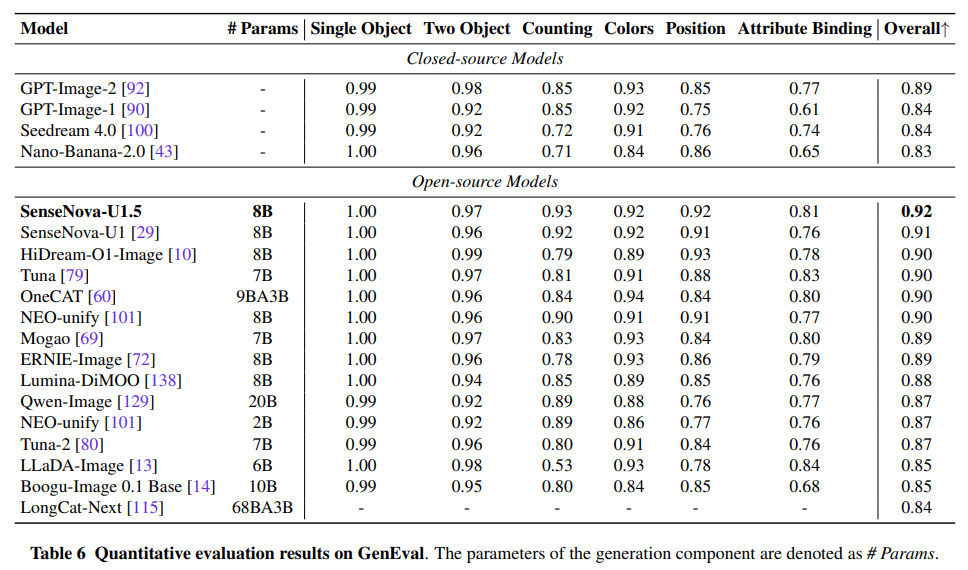
Table 6. Quantitative evaluation results on GenEval
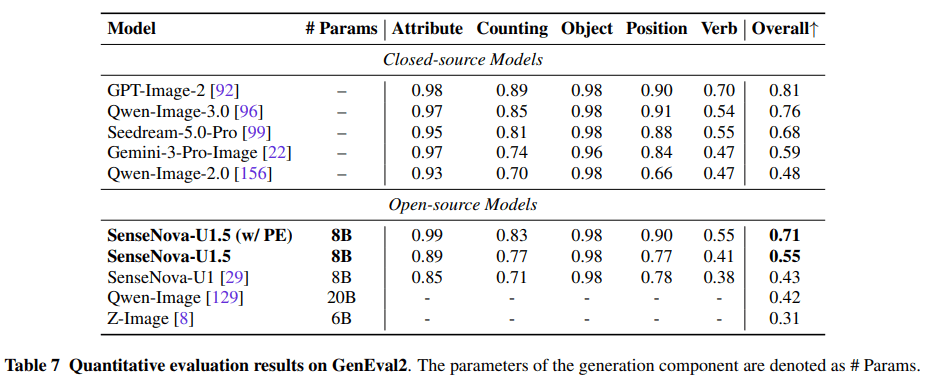
Table 7. Quantitative evaluation results on GenEval2
GenEval. As shown in Table 6, SenseNova U1.5 achieves the best overall performance among open-source models on GenEval, with a score of 0.92, surpassing larger baselines such as SenseNova U1 and Qwen-Image. The most notable improvements are in counting, positional understanding, and attribute binding, while single-object and two-object generation remain consistently strong. These results show that U1.5 not only retains strong foundational object-level generation quality, but also improves compositional consistency and its ability to satisfy multiple visual constraints within a single prompt.
GenEval2. As shown in Table 7, SenseNova U1.5 demonstrates stronger compositional reasoning and instruction-following capabilities under complex constraints. With prompt enhancement, it significantly outperforms all evaluated open-source baselines while further narrowing the gap with leading proprietary systems. Improvements are particularly notable in attribute-, counting-, and verb-related generation, indicating that the model is better able to represent object properties, quantities, and interactions. Notably, SenseNova U1.5 more faithfully transforms structured, relation-dense prompts into coherent visual compositions, especially when multiple constraints must be satisfied simultaneously.
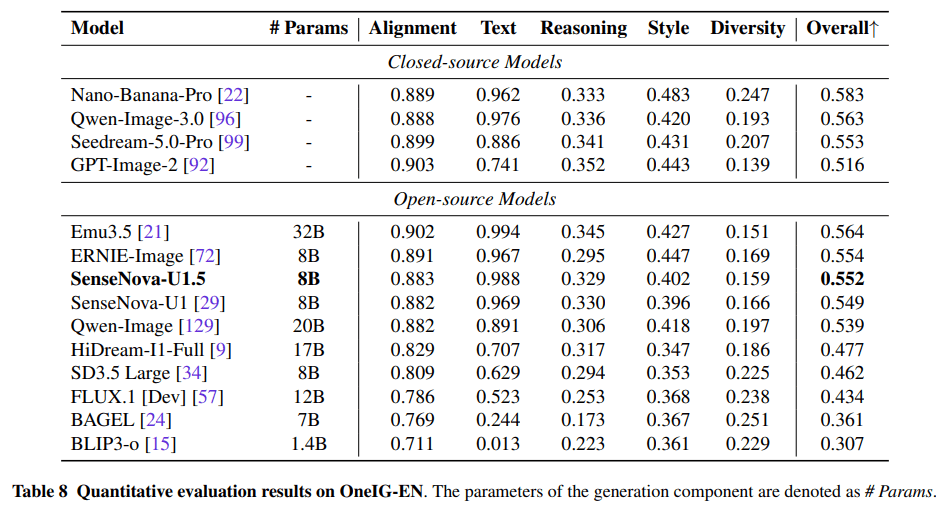
Table 8. Quantitative Evaluation Results on OnelG-EN.
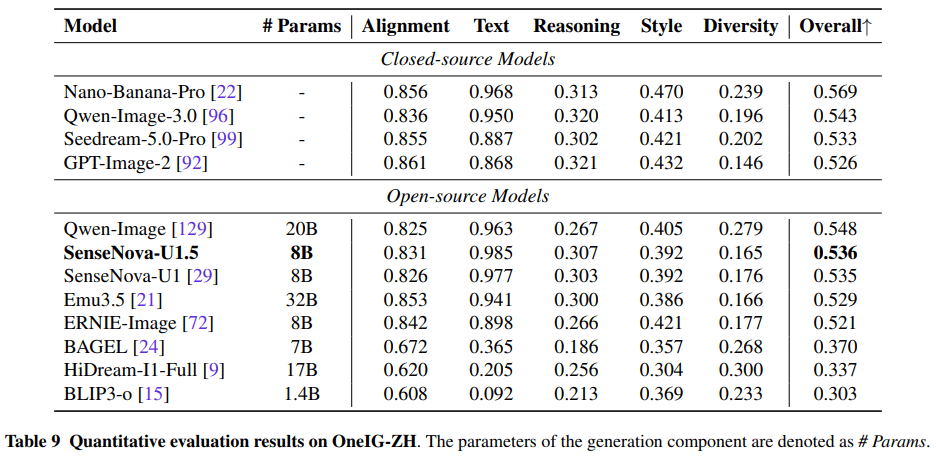
Table 9. Quantitative Evaluation Results on OnelG-ZH.
OneIG-Bench. As shown in Tables 8 and 9, SenseNova U1.5 demonstrates balanced generation capabilities in both English and Chinese evaluations. Its most prominent advantage lies in bilingual text-centric generation. In addition, despite its relatively compact size of just 8B parameters, the model remains competitive in alignment, reasoning, and style scores. This balanced performance is particularly important in real-world generation scenarios, which require accurate text layout, semantic consistency, and visual quality to be achieved simultaneously rather than optimized independently.
DPG-Bench. As shown in Table 10, SenseNova U1.5 achieves an overall score of 88.11, ranking among the best-performing open-source models. It delivers consistently strong results across entities, attributes, relationships, and other fine-grained dimensions, reflecting robust semantic grounding and compositional fidelity. Compared with SenseNova U1, U1.5 improves the overall score while maintaining balanced performance across different prompt components, indicating that it can follow complex, structured instructions more reliably during generation.
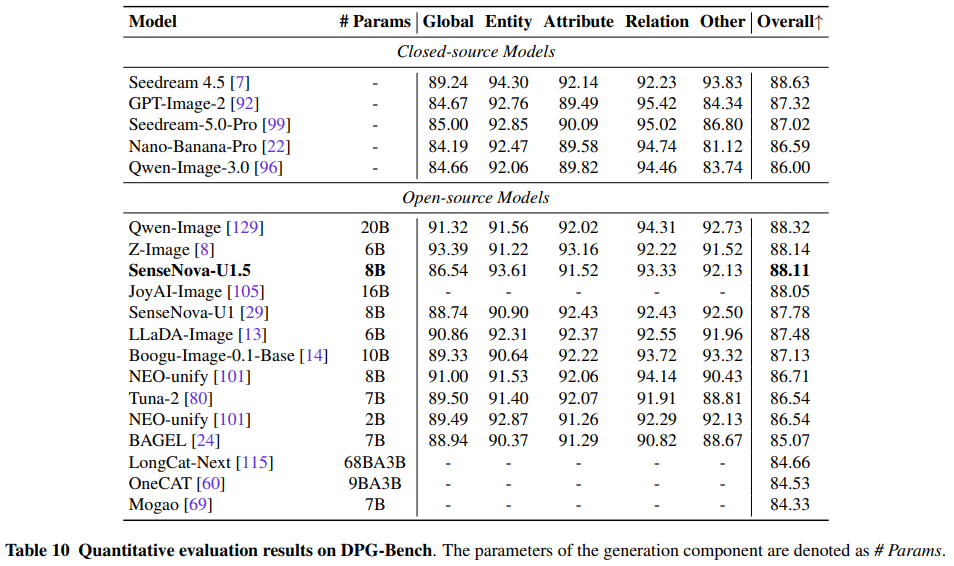
Table 10. Quantitative Evaluation Results on DPG-Bench.
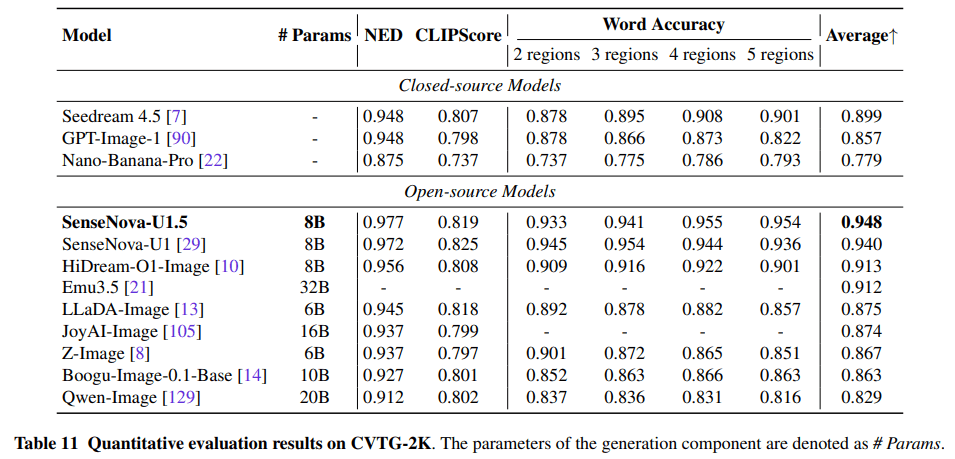
Table 11. Quantitative Evaluation Results on CVTG-2K.
Text-Centric Generation. We further use CVTG-2K and LongText-Bench to evaluate text rendering in more demanding text-centric scenarios, focusing on multi-region layouts and long-form bilingual text generation.
CVTG-2K. As shown in Table 11, SenseNova U1.5 achieves the best overall performance among all evaluated models, with an average score of 0.948. Notably, it demonstrates particularly substantial improvements in dense text rendering, maintaining word accuracy above 0.95 even in the more challenging four-region and five-region settings. Compared with SenseNova U1, U1.5 further improves NED and word accuracy under conditions with a larger number of regions, while maintaining a similar CLIPScore. This indicates that the model offers greater text fidelity and robustness as the amount of rendered text increases.
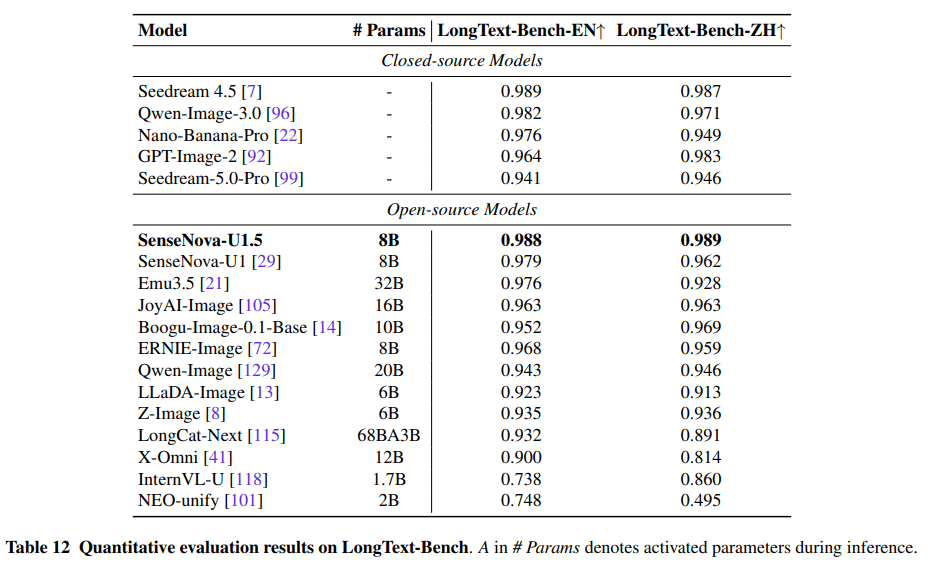
Table 12. Quantitative evaluation results on LongText-Bench.
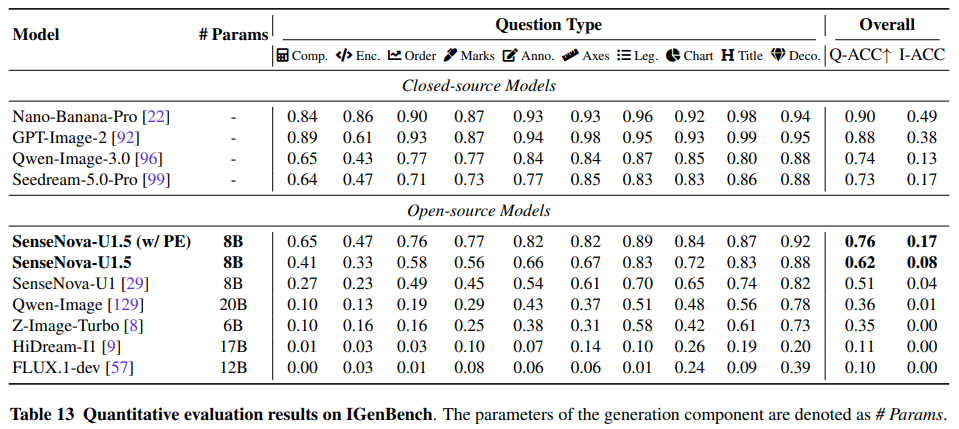
Table 13. Quantitative evaluation results on IGenBench.
LongText-Bench. As shown in Table 12, SenseNova U1.5 achieves leading open-source performance in both the English and Chinese tracks, with particularly significant improvements over SenseNova U1 in Chinese. Its accuracy remains robust as text length and layout complexity increase, indicating improved stability in dense, structured, and bilingual text rendering.
Complex infographic generation. We further use IGenBench and BizGenEval to evaluate SenseNova U1.5 on complex infographic and business content generation. These benchmarks require models to simultaneously satisfy requirements for textual content, layout organization, chart semantics, visual attributes, and domain knowledge.
IGenBench. As shown in Table 13, SenseNova U1.5 already achieves the strongest open-source performance without prompt enhancement and improves further with PE. These improvements indicate that the model generates infographics more reliably and has stronger capabilities for structured visual planning, although a gap remains between it and the strongest proprietary systems.
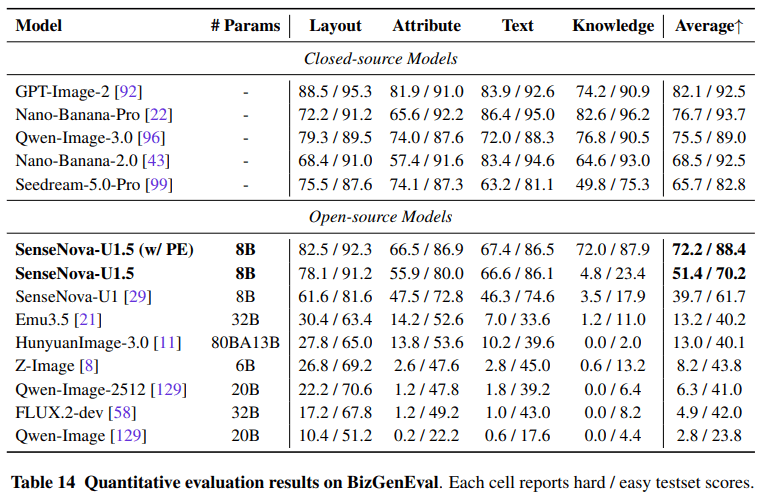
Table 14. Quantitative evaluation results on BizGenEval.
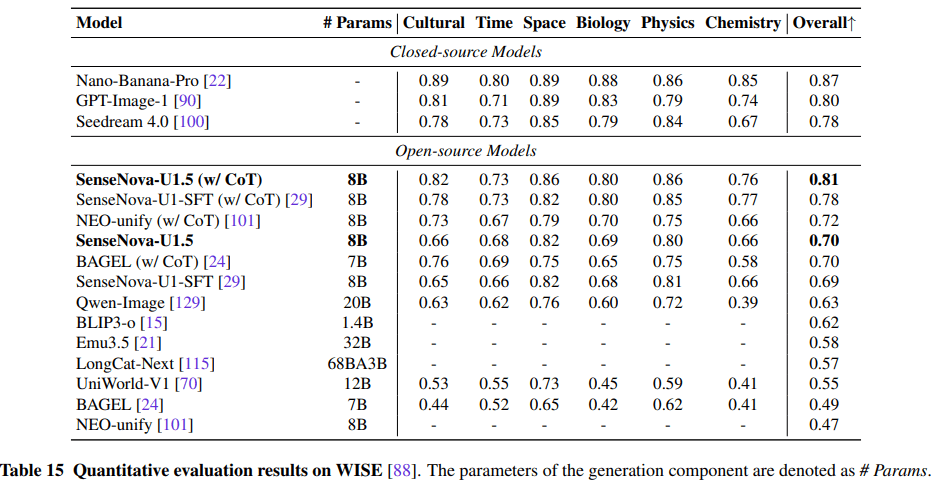
Table 15. Quantitative evaluation results on WISE.
BizGenEval. As shown in Table 14, SenseNova U1.5 significantly outperforms SenseNova U1 on both the easy and hard splits, and achieves leading open-source performance with prompt enhancement. These gains are particularly pronounced on knowledge-intensive examples, while remaining consistent across layout-, attribute-, and text-related dimensions.
Reasoning-centric generation. We further use WISE to evaluate knowledge-intensive and reasoning-intensive generation capabilities across cultural knowledge, time, space, biology, physics, and chemistry.
WISE. As shown in Table 15, SenseNova U1.5 is already competitive without chain-of-thought (CoT) reasoning. Enabling CoT leads to substantial performance improvements and delivers leading open-source performance. The gains are particularly pronounced in knowledge-intensive domains such as cultural knowledge, biology, and chemistry, highlighting the value of explicit reasoning for grounding visual generation in world knowledge.
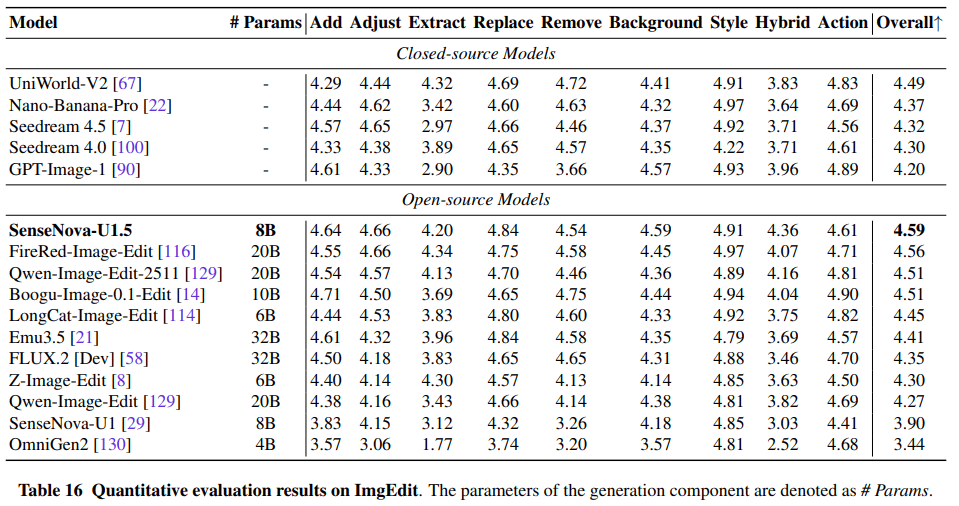
Table 16. Quantitative evaluation results on ImgEdit.
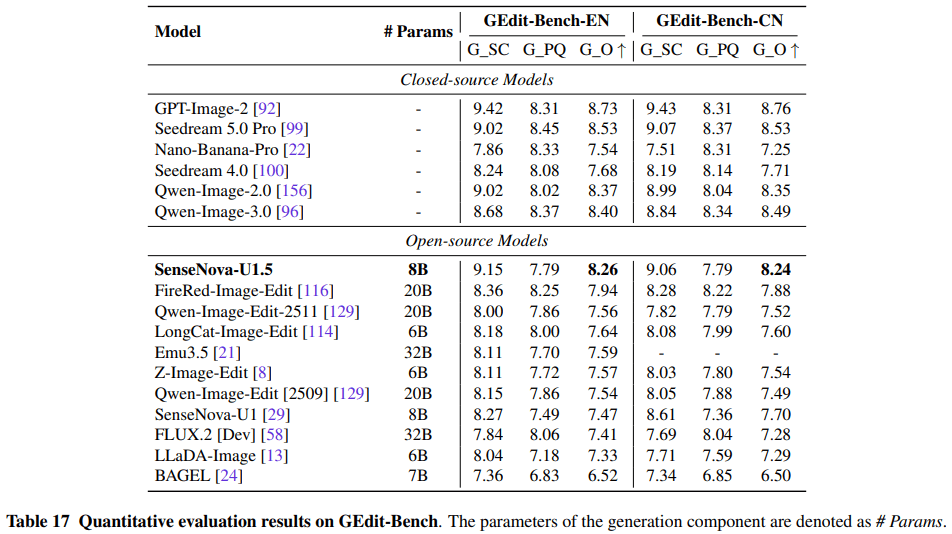
Table 17. Quantitative evaluation results on GEdit-Bench.
5.3 Image Editing
General-purpose editing. We evaluate general-purpose editing capabilities on ImgEdit, GEdit-Bench, WeEdit, and OmniRef-Bench, covering a range of editing types, semantic consistency, text-centric editing, and reference-image-based editing.
ImgEdit. As shown in Table 16, SenseNova U1.5 delivers the strongest overall performance across a broad range of editing types, representing a significant improvement over SenseNova U1. These gains are consistent across categories, indicating that the model has stronger editing execution capabilities while preserving the source image」s content and visual quality.
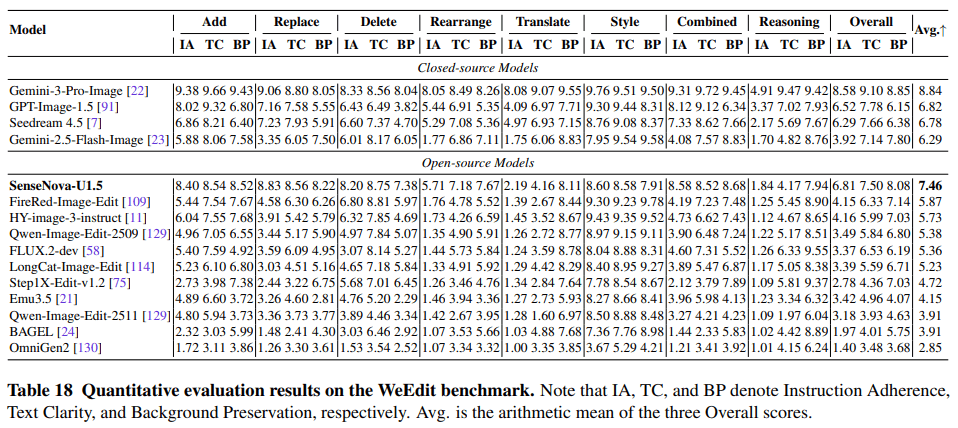
Table 18. Quantitative evaluation results on the WeEdit benchmark.
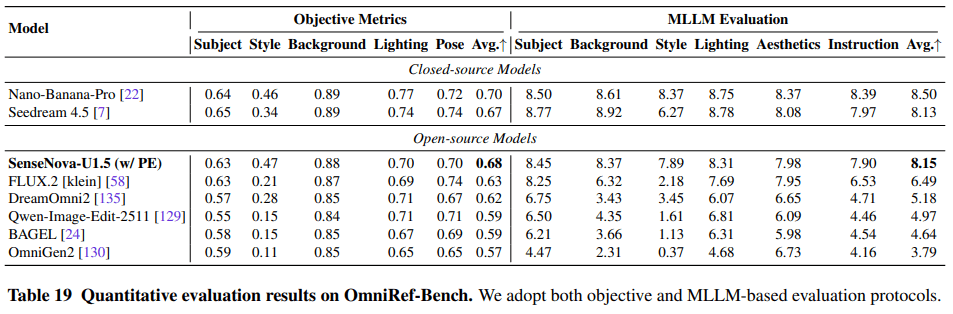
Table 19. Quantitative evaluation results on OmniRef-Bench.
GEdit-Bench. As shown in Table 17, SenseNova U1.5 achieves the strongest overall performance. The gains are particularly pronounced in semantic consistency, indicating that the model can more reliably identify the intended edits, modify the correct visual content, and preserve the semantic context of the original image. At the same time, U1.5 remains competitive in perceptual quality, showing that improved instruction execution does not come at the expense of visual realism or local coherence. This reflects a better balance among editing accuracy, content preservation, and overall image quality.
WeEdit. As shown in Table 18, SenseNova U1.5 significantly outperforms other open-source models and remains competitive with leading proprietary systems. Its strong performance in instruction following, text clarity, and background preservation demonstrates robust text-centric editing capabilities: it accurately carries out the requested text modifications while keeping unrelated visual content intact. The results further indicate improved coordination between semantic editing and visual reconstruction. However, translation-related and reasoning-intensive edits remain relatively challenging, suggesting that tasks requiring deeper language and contextual understanding still have room for improvement.
OmniRef-Bench. As shown in Table 19, SenseNova U1.5 achieves the leading open-source performance on OmniRef-Bench under both objective metrics and the two evaluation protocols based on multimodal large language models (MLLMs). The gains are particularly notable in style consistency and background preservation, indicating that the model can make more effective use of reference information while minimizing unintended modifications to the target image. In addition, stronger subject and pose consistency show that identity, appearance, and structural cues can be reliably preserved across a range of editing conditions. These results indicate that U1.5 not only improves reference fidelity but also achieves a better balance among reference utilization, transformation accuracy, and preservation of the original scene—an essential capability for robust multi-reference image editing and customized editing.
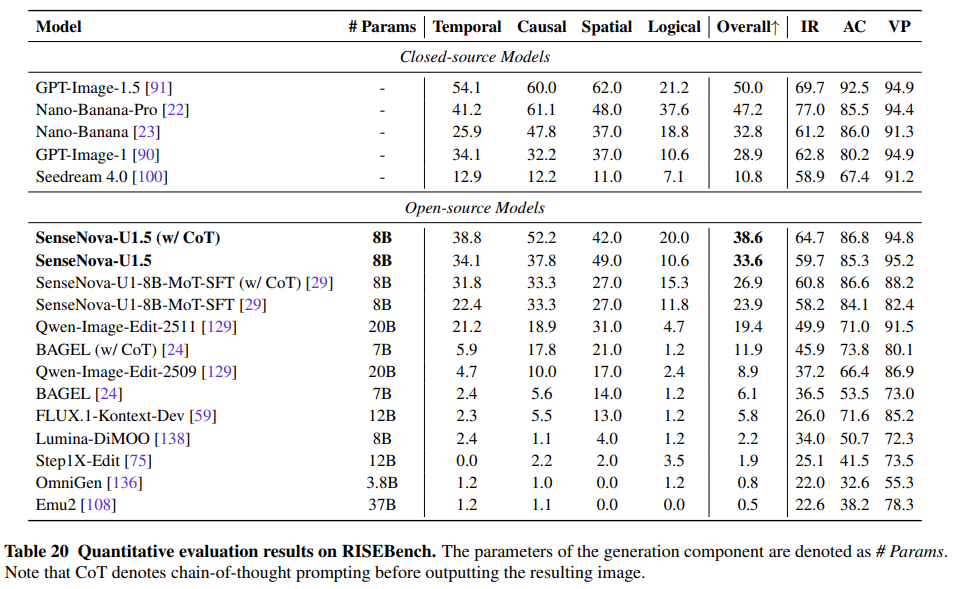
Table 20. Quantitative evaluation results on RISEBench.
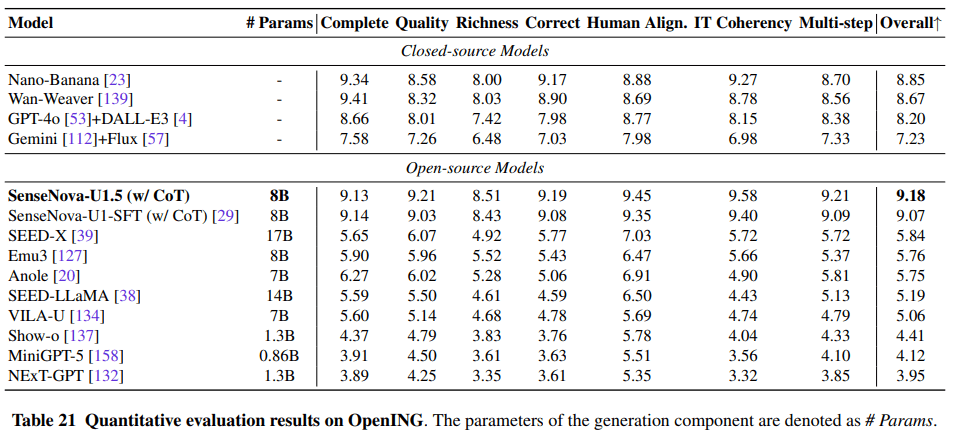
Table 21. Quantitative evaluation results on OpenING.
Reasoning-centric editing. In addition to directly following instructions, we further use RISEBench to evaluate editing tasks in which the model must infer temporal, causal, spatial, or logical consequences before modifying an image.
RISEBench. As shown in Table 20, SenseNova U1.5 outperforms the evaluated open-source baselines even without CoT, while explicit reasoning delivers a further substantial improvement. The gains are most pronounced in causal, logical, and temporal editing, suggesting that CoT is particularly effective when the required transformation must first be inferred rather than located directly. By contrast, the benefits for spatial editing are less consistent, indicating that explicit reasoning is more valuable for implicit multi-step transformations than for edits where the visual evidence can be accessed directly.
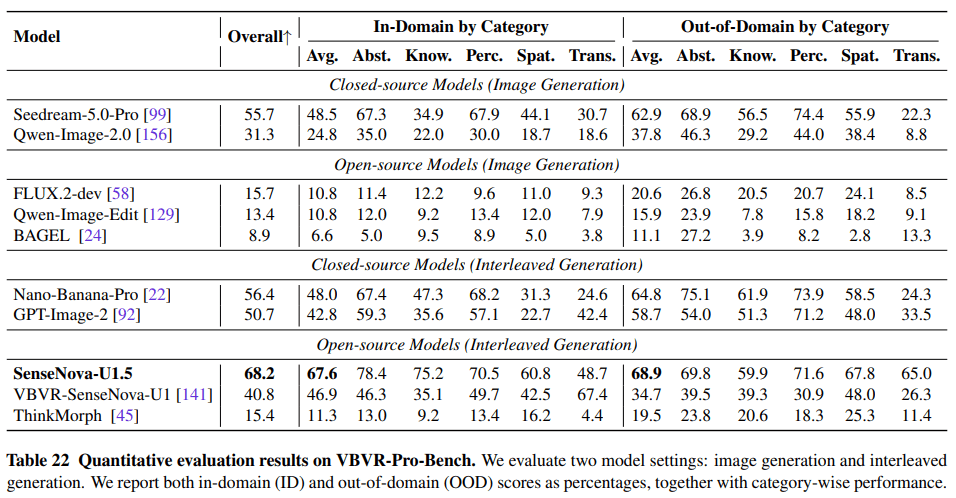
Table 22. Quantitative evaluation results on VBVR-Pro-Bench.
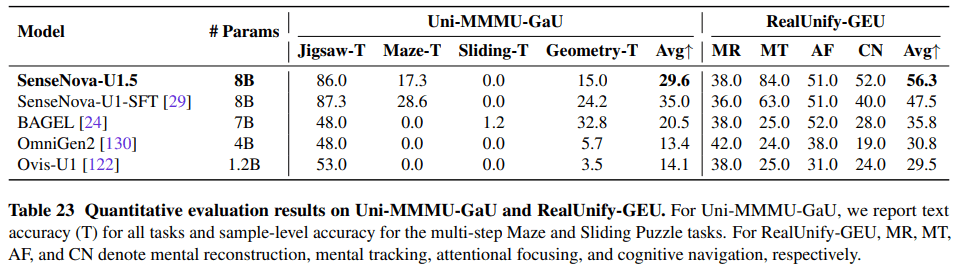
Table 23. Quantitative evaluation results on Uni-MMMU-GaU and RealUnify-GEU.
5.4 Interleaved Generation
Interleaved generation. We evaluate this capability on OpenING and VBVR-Pro-Bench. These benchmarks integrate understanding, reasoning, and generation to assess open-ended interleaved generation and generation-mediated visual reasoning.
OpenING. As shown in Table 21, SenseNova U1.5 with CoT achieves the leading overall performance on OpenING, outperforming SenseNova U1 as well as the proprietary system pipelines included for comparison. Its strong results in text–image coherence, human alignment, and multistep consistency demonstrate reliable open-ended interleaved generation capabilities.
VBVR-Pro-Bench. As shown in Table 22, SenseNova U1.5 achieves new state-of-the-art results across different cognitive capabilities, demonstrating its ability to reason directly through interleaved text–image generation. It also generalizes strongly to out-of-domain tasks, outperforming leading proprietary models such as Nano-Banana-Pro and GPT-Image-2.
Unified reasoning. Uni-MMMU evaluates generation-aided understanding (GaU), while RealUnify evaluates generation-enhanced understanding (GEU) through reconstruction, tracking, focusing, and navigation.
Uni-MMMU-GaU and RealUnify-GEU. As shown in Table 23, SenseNova U1.5 achieves leading performance on RealUnify-GEU, with a substantial improvement over SenseNova-U1-SFT. At the same time, it remains competitive with the previous-generation SenseNova models on Uni-MMMU-GaU. These findings indicate that in SenseNova U1.5, generation is not merely an output modality; it can also serve as an intermediate representation that supports multimodal reasoning and understanding.
6 Conclusion
We introduce SenseNova U1.5, taking a further step toward native multimodal systems in which visual understanding and generation are learned within a shared computational foundation rather than connected through separate perception and generation pipelines. Extensive experimental results show that this approach can extend beyond basic image synthesis: compact native representations can effectively support high-fidelity generation, editing, interleaved generation, and reasoning-intensive visual tasks while maintaining strong understanding capabilities.
From a broader perspective, SenseNova U1.5 shows that the core value of multimodal unification lies not in simplifying the architecture, but in enabling capabilities to interact. Reasoning can improve how visual content is created and transformed, while generation itself can become part of the model」s internal process for solving visual problems. This blurs the traditional boundary between perception and creation and points toward a new class of foundation models: In these models, seeing, reasoning and generating are no longer trained as loosely coupled functions, but emerge as different expressions of shared visual intelligence. We believe this represents an important step toward a class of multimodal models that do more than combine different modalities—they develop unified mechanisms for interpreting, imagining and acting on the visual world.