
The Only One Nationwide! SenseCore Lingang AIDC Receives Dual 5A Certifications for Compute Efficiency and Compute–Energy Coordination
At the Compute Energy Collaboration for High-Quality Development Forum, themed "Building on Zero-Carbon Foundations, Weaving a Compute–Energy Network," held during the 2026 China Computing Power Conference, the China Academy of Information and Communications Technology (CAICT) officially released the results of its compute–energy collaboration assessment and certification program.
SenseCore Lingang AIDC received CAICT's highest compute–energy collaboration rating—AAAAA—becoming the first computing center in the industry to pass the assessment. As one of Asia's largest AI computing centers, SenseCore Lingang AIDC had previously received the nation's first 5A certification for an intelligent computing center. With this latest AAAAA certification for compute–energy collaboration, it is now the only intelligent computing center nationwide to hold dual 5A certifications for compute efficiency and compute–energy collaboration.
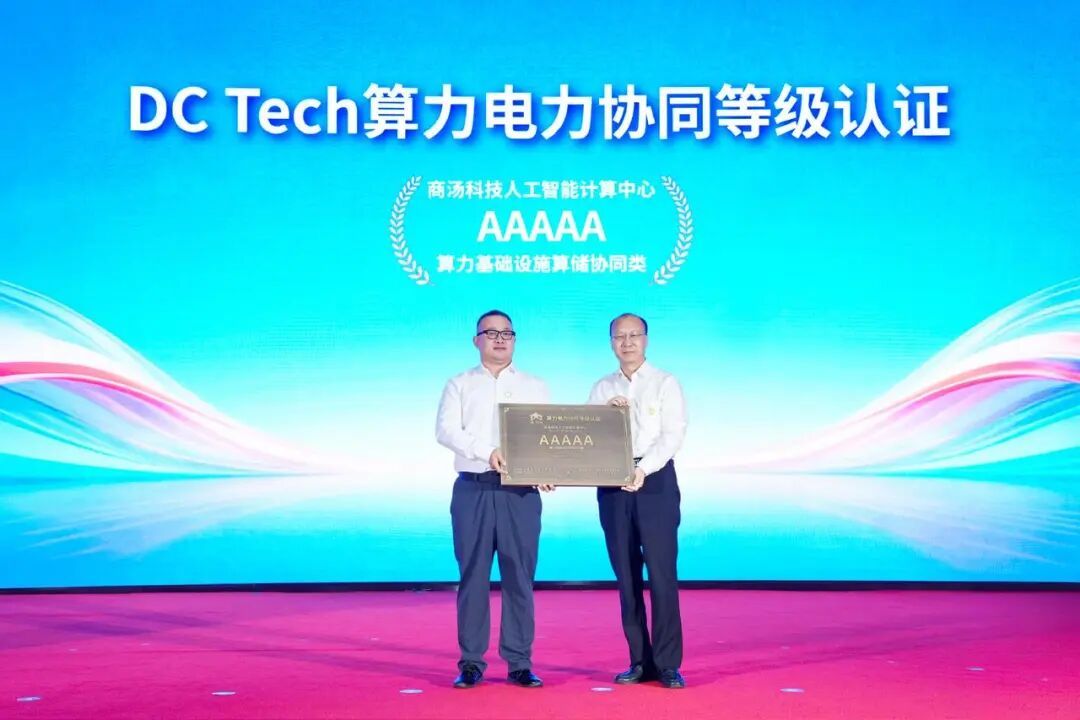
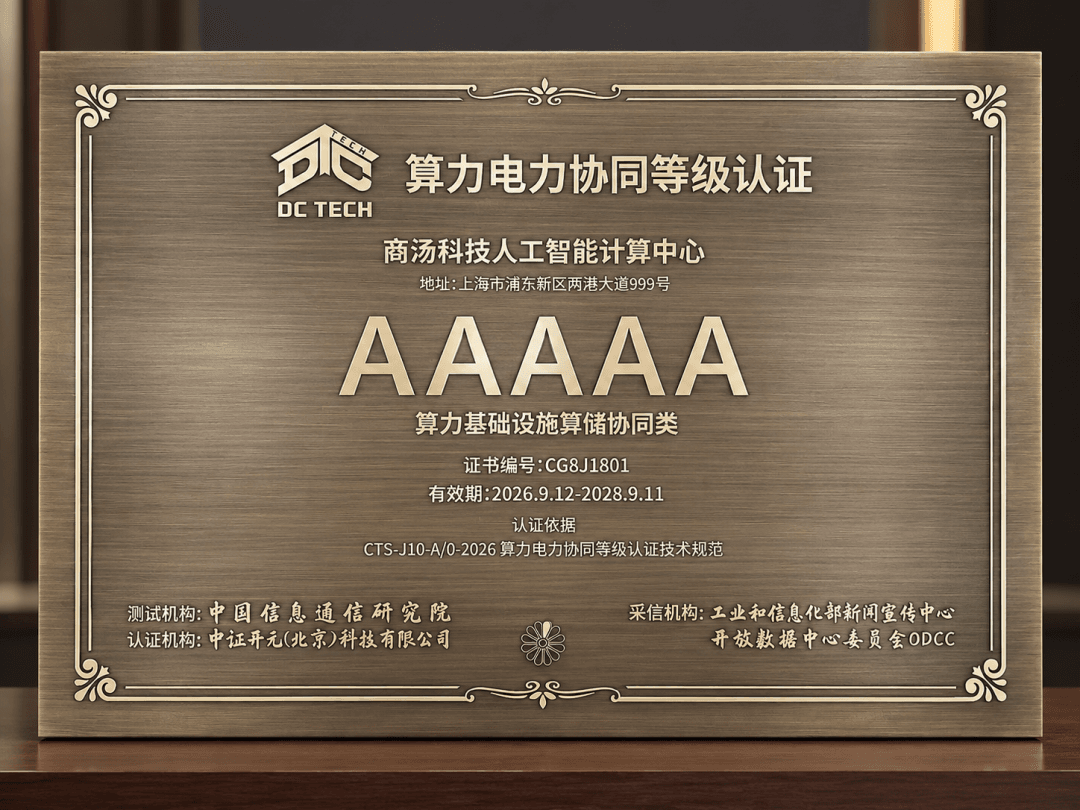
He Baohong, Chief Engineer of the China Academy of Information and Communications Technology, presents SenseCore with the certification.
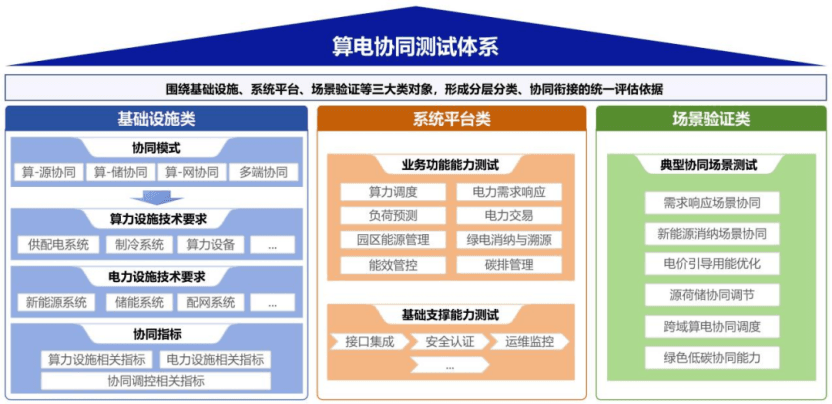
In 2026, CAICT introduced a compute–energy collaboration testing framework. Covering three assessment subjects—infrastructure, system platforms, and scenario validation—the framework establishes a unified, tiered and categorized evaluation benchmark with coordinated links across different areas. At the same time, through its standards research and working groups, CAICT is actively improving the compute–energy collaboration standards system. Core standards covering general fundamentals, equipment and facilities, platform scheduling, and green and low-carbon development have been initiated or planned, providing a consistent basis for testing and certification.
The compute–energy collaboration assessment undertaken by SenseCore Lingang AIDC covered three areas—economic performance, reliability, and operations and management—and comprised 11 test items. It evaluated the computing center's overall capabilities in energy storage coordination, electricity cost optimization, load regulation, demand response, safety assurance, and platform operations. The assessment included:
First, user electricity cost optimization, with a focus on the overall reduction in electricity costs achieved through measures such as peak-valley energy storage arbitrage;
Second, peak shaving and valley filling of the park's load, focusing on calculating the reduction in the peak-to-valley differential and optimizing the park's overall electricity consumption profile;
Third, support for grid demand response, with a focus on testing energy storage systems' ability to receive grid instructions and provide interactive services;
Fourth, energy storage safety protection, covering reliability indicators including hardware safety, fault ride-through, and emergency backup power supply;
Fifth, the platform scheduling, operations, and maintenance system, covering capabilities including data monitoring, battery status assessment, bidirectional interfacing with multiple systems, and tiered alarm protection.
Drawing on its mature practices in coordinating computing power and energy management, SenseCore Lingang AIDC performed strongly across all individual assessments and successfully passed the highest-level AAAAA certification.
PART01
Deep Compute–Energy Collaboration: Building the Next Generation of Intelligent Computing Infrastructure
Electricity is becoming a key factor influencing the large-scale development of AI infrastructure. Ensuring a stable supply of computing energy while improving energy efficiency, optimizing electricity costs, and strengthening coordination with the power grid has become a new challenge for intelligent computing center operators.
To address this challenge, SenseCore drew on its long-term experience operating the Lingang AIDC and partnered with CATL to develop a new energy storage system with a capacity of 17.888 MW/35.776 MWh. Building on years of experience operating intelligent computing centers, SenseCore also independently developed and launched a computing-energy coordination platform, which was first deployed at the Lingang AIDC. Integrating capabilities including an energy large model and an energy storage system, the platform establishes an "eight-level data penetration architecture" and "five intelligent decision chains." It connects computing resource scheduling, electricity price forecasting, energy storage optimization, capacity control, energy consumption management, and Token output optimization, enabling precise matching among computing resources, energy, and business operations while continuously improving the operational efficiency of intelligent computing centers and energy utilization efficiency.
Data first, intelligence second: The SenseCore computing-energy coordination platform makes "end-to-end data connectivity" its top priority. It connects five types of systems—the computing resource scheduling platform, power distribution monitoring, the energy storage BMS, HVAC and cooling controls, and power trading interfaces—and establishes an eight-level data link spanning from the park level (grid connection point) to the equipment level (individual GPU). This enables computing tasks to be traced to their sources and energy consumption to be attributed, providing a comprehensive and granular data foundation for computing-energy coordination.
Forecast-driven decision-making: The platform uses "24-hour rolling forecasts" as the core capability for intelligent scheduling. It models and forecasts IT loads, the total load at the park's grid connection point, and data center PUE, and applies the results to decisions involving energy storage charging and discharging, demand control, and electricity volume declarations. At present, the platform's computing load forecast accuracy remains consistently above 96%, shifting downstream strategies from "passive response" to "proactive planning."
Coordinated regulation of energy storage and computing resources: Energy storage and computing resources can each regulate loads, but both have limitations when used independently: energy storage cannot support long-duration demand response, while reducing computing loads can affect business operations. The SenseCore computing-energy coordination platform combines the two into flexible, adjustable resources for the park. When a demand response instruction arrives, the energy storage system discharges first, responding within milliseconds. If additional adjustment is required, the platform coordinates with the computing side to reduce the load of low-priority offline tasks, together meeting the grid's required load-reduction target. This "combination of measures" design directly supported the subsequent results in practical demand response operations.
For electricity price analysis and coordinated trading, the platform automatically aggregates information on time-of-use electricity prices, spot electricity prices, and demand response compensation prices. It combines this information with load forecasts to calculate returns across multiple scenarios and produce economically optimal energy storage scheduling plans. The platform also connects to power trading declaration interfaces, converting load forecast outputs into references for day-ahead and monthly electricity volume declarations. The declaration deviation rate is controlled within ±2%, significantly outperforming the industry average and reducing the compliance risks associated with market-based trading.
In addition to PUE, the SenseTime computing-energy coordination platform introduces TPW (Tokens per Watt, the number of Tokens produced per unit of electricity cost) as a core management metric. Together with total Token output, energy consumption per unit of computing capacity, and the peak-to-off-peak electricity consumption ratio, it establishes an energy-efficiency end-to-end process covering data collection, anomaly identification, strategy adjustment, and performance review. The introduction of TPW shifts energy efficiency from a cost perspective—how much electricity is saved—to a value perspective—how much intelligent output is generated per unit of electricity. This is consistent with the direction of the subsequent initiative to establish industry standards for computing-energy coordination.
PART02
Computing-Energy Coordination Unlocks Value at Scale, Supporting the Development of Green Intelligent Computing
At present, the SenseTime Lingang AIDC computing-energy coordination platform has delivered tangible results in forecast accuracy, economic returns, environmental benefits, and grid response.
In terms of energy efficiency, the campus's annual PUE is expected to reach 1.24 in 2026, outperforming the 1.25 energy-efficiency threshold for newly built large-scale data centers in China. Based on the current scale, annual carbon emissions reductions are expected to reach 24,000 metric tons per 10,000P.
In terms of economics, coordinated optimization of computing capacity and energy has increased Token output per unit of electricity cost by 80%, while the average electricity tariff is approximately 10% lower than that of IDC facilities in the same region.
In terms of grid coordination, Lingang AIDC has more than 25 MW of demand-response capacity. During Shanghai's 2026 summer peak electricity demand response program, it ranked first among data centers in Shanghai in both core indicators—demand-response volume and fulfillment rate—setting new historical records.
The 5A certification for computing power and electricity coordination awarded by the China Academy of Information and Communications Technology is not only an authoritative recognition of SenseTime's Lingang AIDC capabilities in coordinating computing power and electricity, but also further validates the technical pathway and industry value of the collaborative development of AI computing power and electricity. Looking ahead, SenseCore will continue to advance the deep integration of computing power, electricity and AI applications, driving intelligent computing centers from "large-scale construction" toward "lean operations." This will provide further practical experience for the green, efficient and intelligent development of AI infrastructure, helping the artificial intelligence industry achieve higher-quality and more sustainable growth.